
I love how the soft sea ice forms, bends and cracks over rocks as the tide recedes.
It was -8° C this morning along the shore of the Bay, and the tide was falling.
Life in Nova Scotia
I love how the soft sea ice forms, bends and cracks over rocks as the tide recedes.
It was -8° C this morning along the shore of the Bay, and the tide was falling.
Boo the bad guys, cheer the good guys and coo at the young lovers. That’s the traditional British Pantomime style: no stiff upper lip, no hoity-toity “theatah, dahling,” just good Fun for the Folks in a form that dates back centuries. And no, it has nothing to do with the gentle “mime” of Marcel Marceau. Except that this year’s play takes place in Paris, where you might go to that windmill place to dine on a Folly Burger, and see a tower that’s quite an eye-full. (Get it?)
South Shore Players‘ all-new, original, “The Three Musketeers” has finished its two-weekend run to full houses in the Pearl Theatre in Lunenburg, amazing us again at the wealth of talent around here. The sheer volume of effort that goes into such a community production contributes hugely to local spirit and culture, and the quality of the result instills pride and loyalty to the place.
Written by Jon Allen and Dave Brumwell, two transplanted Brits with fine comedic skills and a love of playing to a crowd in outrageous costumes, “The Three Musketeers” was full of cleverness and punnyness. Cross-dressing was so prominent that it seemed not to matter whether a part was being played by a man or a woman. Never mind that there are always more women trying out for parts than men, this is a traditional feature of “panto” that gives a delicious freedom to the imagination of both actors and audience, and makes for a lot of laughs.
Half a dozen musicians formed a very fine orchestra which endured numerous disparaging jokes from the actors, all in good fun.
Students from local schools were encouraged to contribute jokes and the winners each had a night to participate in the play, in costume and makeup, thus gaining a first experience on stage.
The Christmas Pantomime has become a multi-generational family tradition for us. Maybe one of us will someday take part….
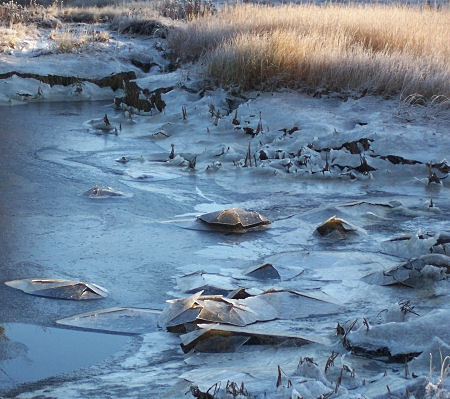
I’m fascinated by the formation of ice and how it interplays with the tides. And it has started again with cold morning temperatures which leave a layer of ice which plays with rocks as the tide goes down. You can hear the cracking as you walk along the shore – just little crick-clicks now, but bigger booms when the ice is thicker.
I made a video called Frosty Morning last year which you can see here.
I’ve been lucky to be able to explore the LaHave River and the LaHave Islands by car, sailboat, dinghy and on foot. It is a very special area. Samuel de Champlain was impressed enough with it when his ship landed in Green Bay in 1604, on their way to Port Royal, to encourage the king of France to establish it as the first capital of New France. And in 1632, Louis XII’s orders to do so were carried out by the Viceroy, Isaac de Razilly.
The first school in Nova Scotia was established there. A new French Acadian school is currently being built outside Bridgewater, not far from the banks of the LaHave River, and the road leading to it will be named after Champlain. (See the website of the École de la Rive-Sud, which I maintain.)
So it is with great pleasure that I unveil a new section of the Nova Scotia Photo Album dedicated to the LaHave River and Islands. Drumroll please…


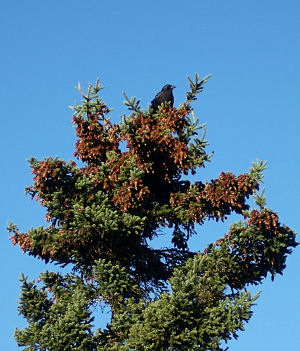
There is a traditional rule that says when the cones are set high in the trees, you can expect a lot of snow the following winter.
If it’s true, and if this tree in Feltzen South on Lunenburg Bay is reliable, then we’d all better make sure our snowblowers and plows are working, to say nothing of getting our backs in shape.
The crow in the picture is staking its claim over a reliable food supply. Crows are no fools.
So we’ll see what the winter brings. Remember, you saw it here first…

My husband just spotted this video about Chester Race Week. We sail but we don’t race, so this video gives me a feeling about what it’s like to be involved in this event. It’s Canada’s largest keelboat regatta!

The other day I was contacted by a local chiropractor, Laurie Flavin, who asked if I could help with setting up a web page with a PayPal “DONATE” button so people could help her friend, Jennifer Collins, who lives just outside Lunenburg.
Jennifer, an active mother of 3 boys in their 20s, broke her neck in a freak accident while horsing around with one of her sons last February and was instantly rendered quadriplegic. As she says, she knew right away what had happened because her body went numb, but she stayed calm for her son and asked him to call 911.
Jennifer is blessed with good friends, a supportive family and a positive attitude towards getting better. Right now, as she leaves rehab, her needs are material: a specialized exercise bike that stimulates muscle-nerve connections electrically, and a wheelchair van. Her dream is to get stem cell treatment, but that will involve a trip out of the country. Ultimately, she hopes to be able to take golf lessons as she had been planning before the accident.
You can read more and donate money to Jennifer at JenniferCollins.org.
Nova Scotia has so many beautiful lakes. Some of them are lined with cottages. In Cape Breton family cottages are called “bungalows”. Other lakes are in wilderness areas and may hide traditional camping spots known to a few fishermen, hunters and back-country campers.
I camped out last weekend next to the cottage of friends on Lake George, on the South Mountain near Aylesford, in the Annapolis Valley. We swam and kayaked and wished we had a little sailboat there because it was windy. We hung out and talked and read books and ate. When it was cold we lit a fire. We grabbed the last bit of summer. That’s what cottages are about.
