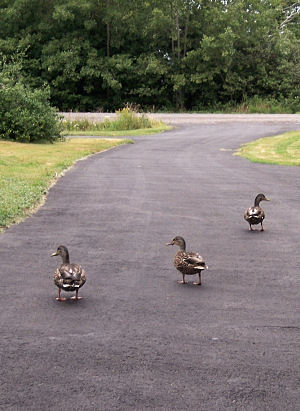
"OK, boys, we're outta here. Let's check things out down the road." E. Sepulchre photo
These intrepid ducks were not at all shy as my husband herded them out of the garden and back down the road. I bet they’re happy now: it’s pouring rain. Danny was briefly a hurricane but is down to a post-tropical storm that will pass south of Nova Scotia on a similar path to Hurricane Bill. After a beautifully sunny, but cool, week, the gardens will love the rain. But weekend campers are out of luck this time.
It seems to have been a bumper year for ducks. Near our place, we’re blessed with lots of natural shoreline where they can build nests. Elsewhere, and where people have the money, they build walls of boulders at the high tide line to shore up their lawns and act as a buffer against erosion. But those neat and tidy rock walls are bad news for nesting shorebirds.
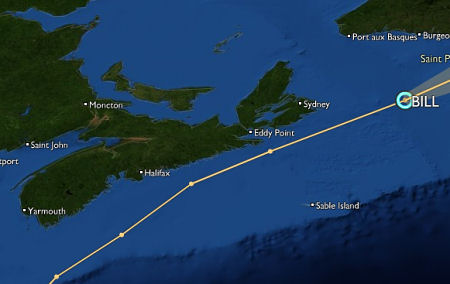
Hurricane Bill ended up not touching the Nova Scotian coast at all. Here’s a map of the final track, from StormPulse.com: Track of Hurricane Bill along the coast of Nova Scotia, August 23, 2009. Image from StormPulse.com.
Lunenburg reported maximum winds of 56 km/hr gusting to 70, Baccaro Point further southwest: 67 gusting to 84. By the time Bill reaches Newfoundland, it should have lost power and been downgraded to a tropical storm.
I’ve made updates to the following sections of the Nova Scotia Photo Album, with new photos:
Panoramas: Note that each panorama is stitched together from two or more photos to give a wide view, more like the eye sees as it scans the scenery. Together they form an extremely unique collection of images from around Nova Scotia.
Halifax – I confess, I’ve only ever lived in Halifax for a summer long ago, so I’m a tourist when I go to Halifax, even if it’s to see a doctor. So much the better for you if you’re planning a trip.
Blue Rocks & Stonehurst – Not far away from us, but so very picturesque, and a fantasy place for kayaks and other small boats.
High tide at Western Shore public wharf, on Mahone Bay, around noon today, as Hurricane Bill passes us about 100 miles offshore. The tide is as high as I’ve ever seen it, but I’ve seen bigger waves when the wind had been sustained and in another direction. We’re morbidly keeping a watch on high tides, knowing that if the sea rises a metre as the ice caps melt, we’re in trouble.
We’re weather watching, having fun trying to understand what we see and building our knowledge about how weather works. Banks of fog are rolling into Mahone Bay. Are they related to the approaching hurricane? Or just the incoming tide? The water has been warm in Mahone Bay lately, and the air hot and humid. Cooler water coming in would cause moisture in the air to condense and form fog. What do you think? Taken from Western Shore at about 6 pm. Layers of fog rolling in.
Hurricane Bill approaching Nova Scotia as seen on StormPulse.com. Click image to see fullscreen current version. Select clouds, windfields and map labels, to get a picture like this.
“Batten down the hatches” – it’s an old expression from the days of “wooden boats and iron men” and describes perfectly what Nova Scotians are doing as Hurricane Bill approaches our shores. Memories of 2003’s Hurricane Juan, which hit Halifax hard, are fresh in our minds. There’s a sense of anticipation in the air, weighted down with high humidity and a fresh breeze. Boat owners are checking moorings, moving boats to safer places, removing canvas to reduce windage and damage, and literally securing the hatches. Everyone is stowing lawn furniture and garbage cans. Apple growers in the Annapolis Valley are concerned for their bumper apple crop, but there isn’t much they can do at this point except wait. And “pray to the rum god,” as a sailor told me as she watched her classic wooden daysailer being hauled out of the water.
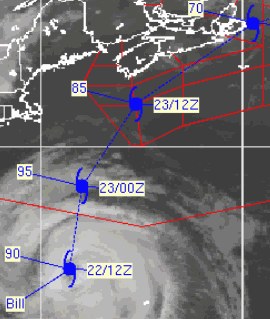
Environment Canada's hurricane track predictions. Click image to see current version.
Bill is currently forecast to pass south of Nova Scotia during the day tomorrow, Sunday as a Category 1 hurricane. I’m monitoring it on two websites: Environment Canada’s marine info section, and the more spectacular and information-rich StormPulse.com. We’ll see which of the two has the more accurate predictions!
Is there any boat more beautiful than a schooner? What is it about them that draws the eye? The Schooner Association met in Chester this weekend. We passed a few heading home on Sunday. Some photos, taken from our boat:
Schooner in Lunenburg Bay.Ocean Racing Class schooner, apparently from Germany, spotted in Mahone Bay on August 9, 2009.
It’s our favourite event of the annual Mahone Bay Classic Boat Festival. Teams of contestants are given 4 hours and limited materials to construct a boat of their own design. The construction takes place in full view of festival-goers. On the last day of the Festival, a crowd gathers for the “sea trials”, in which the contestants must row, then sail, then row and/or sail the boat around a course. There are prizes for best costume, best boat (not necessarily the most seaworthy), and best “water event” – usually a spectacular sinking – as well as for speed.
I made a little video of this year’s Fast and Furious Sea Trials. It’s in two parts.
I woke up this morning with my family aboard a sailboat at a peaceful anchorage in Mahone Bay just a couple of hours sail from home. And shared my thoughts: “We are so privileged to be doing this. Not just having the boat, but to be able to sail where we want and drop the anchor where we deem best, want without paying a toll to anyone, and to enjoy this beautiful scenery so freely.”
Sunset at Covey Island, one of the islands protected by MICA.
The first settlers of Lunenburg must have been in awe at such freedom. What we now call Germany was at the time an assortment of many principalities of various sizes. Going down the “highway” of the river Rhine to Rotterdam, where they boarded the ship that would take them across the Atlantic, the emigrants would have been stopped at every border crossing and paid tolls. Many of them had even needed to secure permission from their feudal lord to leave the land they were bonded to as peasants. Once they reached Lunenburg in 1753, they must have been very appreciative of the freedom to profit from their own labour and build their future with their own hands.
Even some of the modern-day German immigrants to Nova Scotia that I know have expressed to me their appreciation of the freedom they have here in a society that is less regulated than the one they left behind.
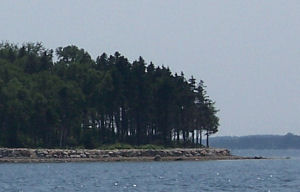
The entire natural coastline of this island has been destroyed and replaced with a rock wall.
The Mahone Islands Conservation Association (MICA) works to protect public access to the islands of Mahone Bay, as well as to preserve their natural environment. The islands are increasingly under pressure by private owners and developers. Natural shorelines and nesting habitats are disrupted (photo right). Owners of some islands chase visitors off beaches that have long been used by the general public. (Some have been known to brandish guns in their efforts, something that Canadians or at least Nova Scotians just don’t do.)
From what I understand, depending on the type of deed, the intertidal zone has legally remained public except in a few cases where water rights were transferred. In a country where travel by boat was the norm, the right to land on a shore would have been an issue of public safety. Nowadays, it seems that there is a trend for private property rights to be extended into the intertidal zone – whether by deed, by custom, by complicity of the authorities or by ignorance by the public, I don’t know. Enlighten me if you know anything more about this issue, please, by commenting below.
Meanwhile, I take pleasure in seeing the decendants of the original Lunenburg settlers, with names such as Meisner and Ernst, involved in MICA, perserving public access to the islands of Mahone Bay for future generations of humans and seabirds.
The highlight of the Tall Ships visiting Lunenburg was seeing Larinda. She’s a replica of a 1767 schooner, built over a period of 26 years by Larry Mahan of Barnstable, Mass. She was a labour of love, full of wood carvings and fancy and fun. Mahan sailed her in many Tall Ships events, where she was much admired. Then in 2003, having taken shelter in Halifax Harbour during Hurricane Juan, she was rammed by another ship during the storm and sank, right next to a sewerage outlet. It was a big mess, and Mahan despaired of ever being able to repair her.
Larinda's stern, reflected in the water of Lunenburg Harbour
The salvaged boat was bought by a Nova Scotia couple who live on St. Margaret’s Bay, and is being carefully restored. Larinda didn’t actually make it to the Halifax Tall Ships event, and hasn’t been fully rigged yet. But she was towed to Lunenburg and rafted up alongside the schooner Unicorn, from whose deck we could admire her. Larinda is sporting a new colour scheme of black, white and bronze instead of green and off-white (see photos of Larinda before the sinking). Her distinctive red battened junk sails were irreparably damaged, and her new sails will be white. The frog in the tricorner hat still graces her bow, and her brasswork is shiny.
Larinda truly is a special ship. It will be exciting to see her sail again.
Larinda's deck, with graceful carvings, is being restored.