Across from the tidal inlet near our house is a small island which is a symbolic destination for us, depending on the time of year. We celebrate spring, and the ice breaking up, by canoeing to it. In winter, if the ice is thick enough, we walk or skate to it. Today the ice was over 6 inches thick, the required minimum, and we walked there.
This morning, as a full moon high tide flooded in, and the air temperature hovered around -15°C, steam rose from the warmer incoming water as it met the cold air.
Steam rising from the bay near Western Shore, Nova Scotia
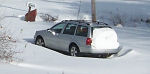
Snowy roadWith thanks to my Facebook friends for their contributions.
The smooth, quiet brush of fresh snow under your skis.
The way ice breaks and cracks over rocks as the tide falls.
Empty beaches with shimmering vistas.
Sea ice and rock, low tideThe mildness, softness and peace a snowfall brings.
Like the folks here, a winter is softness and gentility: quite well mannered, and departs when the welcome is worn.
Snow days!
A crackling fire in a woodstove making heat that penetrates to your bones.
A boy and a buoy
Walking ON the bay in places we usually row, paddle or sail.
Sunlight sparkling off snow-laden branches.
Minas Basin ice shifting, buckling, making strange sculptures on the shore.
Magnificent bald eagles.
Watching the days get longer in the coldest part of the winter.
Icing on the cakeShovelling the driveway with a helper who will clear up the last little bits: the sun.
NO mosquitoes, NO blackflies, NO no-see-ums!
The weather changes frequently: it’s fairly mild, and cold snaps are short, warm periods are also short. There’s something for everyone and no time to get bored!
The province is small but has a variety of microclimates. Want more snow? Ski hills are not so far away. Want less snow? Go walk a deserted South Shore beach.
Ice floes
Memories of crazy winter antics performed when we were young and immortal: descending hills at great speed, jumping from one ice floe to another as the frozen ocean broke up (some have memories of being rescued in these situations!), “getting towed on a sled behind my dad’s car on a snow-covered gravel road, riding my bike through the streets of Halifax when the snow wasn’t too bad,” ice boating, skating on thin ice….
Maple syrup made in the woods.
Alone in a drift
Patterns made by drifting snow.
Winter skies unlike anything you see in the summer.
Eating fresh snow.
Cardinals and purple finches at the feeder.
Getting insight into the life of rabbits from their tracks in the woods.
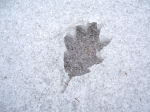
Oak leaf shape in iceSo there are some of the things we love about winter in Nova Scotia. What are yours? Leave a comment below.
Heading west, past Mahone Bay, on Highway 103Turn north at Blockhouse onto the Cornwall RoadAlong the Mushamush River in Middle New CornwallTurn left at Crossroad Farm in Upper New Cornwall. It's for sale, by the way.West on Cross RoadAnother houseFurther along Cross Road, heading westWhich way now? Can't read the sign. Keep to the left.Farm on Cross RoadAh, here we are, at Upper Northfield.
All photos taken on Thursday, January 21, on my way to Pinehurst, just west of Upper Northfield.
The highway through New Brunswick has been greatly improved.
Some take it in stride; others would rather fly. The train is rather nice. I took the bus once – never again. But many, perhaps most, Nova Scotians have done the long drive between Nova Scotia and Ontario (once called Upper Canada) or Quebec (formerly Lower Canada) at least once. Many have gone “down the road” to seek their fortunes and return to Nova Scotia for holidays. Others make the trip regularly, in one direction or the other, with kids in tow.
But doing it in winter? Is it crazy?
We did just that for our Christmas holidays. It certainly is a bit of an adventure. The roads have been improved in recent years, but it’s still necessary to prepare for the unexpected.
Church in Batiscan, Quebec
The new toll highway through the Cobequid Pass in northern NS, which shortens the trip, was closed for 14 hours overnight a couple of years ago during a snowstorm. Imagine a family travelling in a car getting stuck for that period of time. My sister was once delayed for 3 days in northern New Brunswick, in the snow belt between Fredericton and Rivière-du-loup, with her dog. You also have to deal with heavy truck traffic, constantly spraying your windshield and dictating your speed.
The alternative, flying, is iffy too, if your goal is to be “home for Christmas” as I learned by experience years ago. Flights are often delayed by weather, and it is an expensive time of year to fly, especially for a family.
The long drive: just relax and enter the Zone.
So we got our VW diesel Jetta into excellent running order, checked the snow tires, packed provisions and entertainment in case we were delayed en route and had to tuck into a motel for a few days, carried bedding for warmth in case we were stranded by the side of the road, packed extra motor oil and wiper fluid, and even a spare battery, just in case.
Long distance sailors say that if you want to meet up with them, they can promise you a time or a place, but not both. A long winter driving trip is a bit like that. Most of the time, the roads are fine. So we kept our fingers crossed, while preparing for whatever would be thrown our way.
We were lucky this time, with smooth sailing all the way. If we’d returned home one day earlier or later, we’d have found ourselves in a blizzard.
Nature's air filters stand on guard for us the day after a blizzard hit New Brunswick.Out of the water slide and into the pool at top speed, at the Edmundston Best Western Hotel, a great reward for kids after a long drive.
Edmundston, New Brunswick, is a good overnight stopping place for those who aren’t inclined to drive straight through the night. Several hotels cater to people traveling through. Sitting in the hot tub at the Best Western, I chatted with other Nova Scotians, heading either east or west, while our kids enjoyed the water slide. I felt part of a special club of hardy pilgrims keeping alive our family ties and connections to “home”.
I was the “Dessert Queen” in Mahone Bay on Saturday night, receiving desserts people brought to the Mahone Bay Centre, sticking their names on the bottoms of the pie plates so they’d get them back later, sometimes tasting the desserts to find out what they were and if they contained nuts, slicing up cheesecake, apple strudel and blueberry pie….Nice work if you can get it?
It was a benefit for Haiti, to collect money for Oxfam’s Earthquake Emergency Relief Fund. Oxfam has a team in Haiti permanently, so they are well positioned to get aid to people quickly. As we have seen, speed is all important in saving lives and preventing chaos.
The little town of Mahone Bay raised $13,600 for Haiti that night. There were soups, chili, wonderful breads, coffee, cider and desserts, all donated by individuals and businesses in the community. There were musicians donating their talents on 2 stages, and craft tables for kids to make things to sell and to send to children in Haiti. 300 people were fed. We wished we could have sent all that food to Haiti, but money travels lighter.
You can still donate to Oxfam and have it counted in the tally for the South Shore for Haiti event until Jan. 28. Here’s how: Go to www.oxfam.ca, choose “Haiti Earthquake 2010” and in the Comments section enter “Event: South Shore for Haiti”. Or phone 1-800-466-9326 and ask them to note that it is for “Event: South Shore for Haiti”.
Here is an organization I’m proud and happy to have joined – the Nova Scotia chapter of the Business Alliance for Local Living Economies.
Which makes me wonder, as a web designer, what is my contribution to a local, sustainable green economy?
Hmm… well, there’s the commute. Most of the time, I just head downstairs to my home office. No greenhouse gasses are generated. As the downstairs is heated with a radiant floor, it’s the warmest part of the house in winter. So that’s very efficient, but doesn’t quite qualify me as a green business – at least not until we get the planned solar panels up on the roof!
More to the point, however, my clients tend to be folks who operate independent, small (often micro) Nova Scotian businesses. They live and work here by choice, as do many Nova Scotians. It’s not always an easy choice. By running a successful business, however, they are helping others to live and work here as well. I’m happy to be part of that, and strive to contribute to their success. Some are in tourism, some are artists and craftspeople, some are lawyers and some are builders of log and timber frame homes.
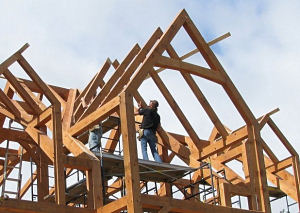
Arlington Frame Company raising a timber frame in Cape Breton
The timber framers in particular are quite aware that they add value to the forest simply by using wood for something more enduring than pulp fibre. Hardwoods such as oak and elm are prized by builders and their clients, as are large softwood trees such as pine. The companies that drive the clearcutting of the forests would rather eliminate the hardwoods with herbicides and harvest the faster-growing softwood trees for pulp.
Timber frame homes are built to last a long time. Their interiors are a celebration of the beauty of wood and craftsmanship. They are usually enclosed with energy-efficient materials. So they provide enduring value on many levels and make a solid contribution to the local living economy.
A visit to the Nova Scotia Museum of Industry in Stellarton made me realize how self-sufficient Nova Scotia used to be, from the growing of food to the manufacture of automobiles! It is a direction we need to move towards again. The reasons are both environmental and economic. A secure, local food supply and lower greenhouse gas emissions are part of it. And by supporting local businesses, we keep more money circulating in the local economy, and we all benefit.
So kudos to the people who started up BALLE-Nova Scotia for getting the balle rolling!
… I think. At least the sun has come out as the temperatures dive well below freezing. After several days of hovering around the 0°C mark, the sun rose to -14°C. Time for a walk.
Steam rises from the water of Mahone Bay in the early morning sunThe sun rises behind islands in Mahone BayThe rising sun kisses the snow
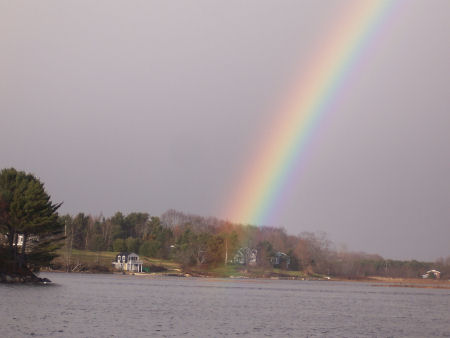
I was chasing rainbows again yesterday. So what exactly does the end of the rainbow look like? In this picture, the rainbow comes down in front of the trees and lands in the water. Actually, there used to be an island there; now it’s a shoal, where seagulls and cormorants like to roost. Someone, apparently, thought the Oak Island treasure had to be there, and dug up the island (which is located near Oak Island), looking for it. If there’s a pot of gold at the end of the rainbow, maybe he was right!