
Autumn is coming to Nova Scotia

Life in Nova Scotia
Nova Scotia has so many beautiful lakes. Some of them are lined with cottages. In Cape Breton family cottages are called “bungalows”. Other lakes are in wilderness areas and may hide traditional camping spots known to a few fishermen, hunters and back-country campers.
I camped out last weekend next to the cottage of friends on Lake George, on the South Mountain near Aylesford, in the Annapolis Valley. We swam and kayaked and wished we had a little sailboat there because it was windy. We hung out and talked and read books and ate. When it was cold we lit a fire. We grabbed the last bit of summer. That’s what cottages are about.

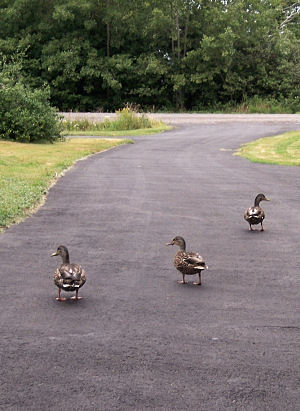
These intrepid ducks were not at all shy as my husband herded them out of the garden and back down the road. I bet they’re happy now: it’s pouring rain. Danny was briefly a hurricane but is down to a post-tropical storm that will pass south of Nova Scotia on a similar path to Hurricane Bill. After a beautifully sunny, but cool, week, the gardens will love the rain. But weekend campers are out of luck this time.
It seems to have been a bumper year for ducks. Near our place, we’re blessed with lots of natural shoreline where they can build nests. Elsewhere, and where people have the money, they build walls of boulders at the high tide line to shore up their lawns and act as a buffer against erosion. But those neat and tidy rock walls are bad news for nesting shorebirds.
Is there any boat more beautiful than a schooner? What is it about them that draws the eye? The Schooner Association met in Chester this weekend. We passed a few heading home on Sunday. Some photos, taken from our boat:


I woke up this morning with my family aboard a sailboat at a peaceful anchorage in Mahone Bay just a couple of hours sail from home. And shared my thoughts: “We are so privileged to be doing this. Not just having the boat, but to be able to sail where we want and drop the anchor where we deem best, want without paying a toll to anyone, and to enjoy this beautiful scenery so freely.”

The first settlers of Lunenburg must have been in awe at such freedom. What we now call Germany was at the time an assortment of many principalities of various sizes. Going down the “highway” of the river Rhine to Rotterdam, where they boarded the ship that would take them across the Atlantic, the emigrants would have been stopped at every border crossing and paid tolls. Many of them had even needed to secure permission from their feudal lord to leave the land they were bonded to as peasants. Once they reached Lunenburg in 1753, they must have been very appreciative of the freedom to profit from their own labour and build their future with their own hands.
Even some of the modern-day German immigrants to Nova Scotia that I know have expressed to me their appreciation of the freedom they have here in a society that is less regulated than the one they left behind.
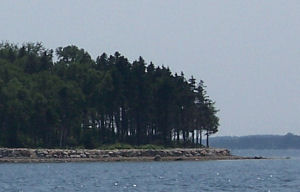
The Mahone Islands Conservation Association (MICA) works to protect public access to the islands of Mahone Bay, as well as to preserve their natural environment. The islands are increasingly under pressure by private owners and developers. Natural shorelines and nesting habitats are disrupted (photo right). Owners of some islands chase visitors off beaches that have long been used by the general public. (Some have been known to brandish guns in their efforts, something that Canadians or at least Nova Scotians just don’t do.)
From what I understand, depending on the type of deed, the intertidal zone has legally remained public except in a few cases where water rights were transferred. In a country where travel by boat was the norm, the right to land on a shore would have been an issue of public safety. Nowadays, it seems that there is a trend for private property rights to be extended into the intertidal zone – whether by deed, by custom, by complicity of the authorities or by ignorance by the public, I don’t know. Enlighten me if you know anything more about this issue, please, by commenting below.
Meanwhile, I take pleasure in seeing the decendants of the original Lunenburg settlers, with names such as Meisner and Ernst, involved in MICA, perserving public access to the islands of Mahone Bay for future generations of humans and seabirds.


Dennis Robinson writes:
This butterfly came to me yesterday. He started out by alighting on my knee and ended up drinking generous quantities of cranberry juice, strawberry juice and Welches grape juice from concentrate. I think he (or she) liked the grape juice best.
He sipped it off the end of my finger but later actually took some out of a teaspoon. He was very tame and seemed to be well aware that I was trying to help him. You can see that someone, possibly a bird, had taken a small chunk out of his back wings but he was in good spirits and very friendly. This is the first time that that I’ve had such an encounter. I have other pictures of him on my knee curling up his proboscis but this will do for now…
(It’s probably a moth, due to its coloration, hairy body, and antennae which are smooth but not clubbed at the end.)
Since we live and sail on Mahone Bay and have come to know most of its islands by sight, I read Frank Parker Day’s 1928 novel Rockbound with great interest. I wasn’t the only one. Thanks to CBC’s Canada Reads program, the previously obscure novel has been lionized by the Canadian literary establishment and the public.
One of the book’s biggest fans is my mother. She has read it several times. When I took her sailing around East Ironbound Island, the setting for the novel, the binoculars and cameras were in constant use.
If Day’s characters were as thinly disguised as his settings, it’s no wonder that the locals he met on Ironbound felt betrayed by his portrayal of hard-drinking, feuding fishing families eking out a hardscrabble living on a small island. But they are long gone now, and new generations of readers marvel at the dramatic sweep of his story, his vivid characterizations and the detailed portrayal of pre-industrial fishing. For me, Rockbound has made the outer islands of Mahone Bay come alive with the ghosts of those who have gone before. Imagine rowing from Tancook to Ironbound, from Ironbound to Pearl (“Barren Island” in the novel) – well, I can’t, really, but characters that I have come to care for do just that in the novel, so I believe it is possible.

When I heard that Two Planks and a Passion Theatre Company was developing Rockbound as a musical, I was astonished and very curious. Written by Allen Cole and under development since 2006, it is now playing “off the grid” (outdoors) at the Ross Creek Centre for the Arts, half an hour north of Wolfville. My mother and I, both very excited, went last Wednesday.
From the opening song, my questions and doubts about how a musical format would serve the story were laid to rest. My ears were awash in delicious sound and my jaw remained in my lap for much of the performance. Harmonically and rhythmically complex and expressive, the music transcends genres and beautifully evokes the epic story and the setting. The acting and singing were wonderful. How else could this play have been done? The music elevates the story, poeticizes it, universalizes it.
I hope to see Rockbound again when it comes to Chester Playhouse August 13-16. Meanwhile it is playing until August 9 at Ross Creek. Not to be missed.

Beyond the waves rolling into one of Queensland’s beaches on St. Margaret’s Bay, a windsurfer in a full-body wetsuit spent the afternoon learning to master his board. Meanwhile, an afternoon party rolled on at a cottage on a sheltered pond separated from the ocean by a bar of rocks and sand. Some of the guests enjoyed taking turns in a rowboat. Others swam in the warm pond.

I’m determined to develop a garden on this corner of our property. Grass won’t even grow there, just weeds and wild strawberries. Over the 5 years that we’ve lived here, I’ve cleared a 15’x15′ patch and tried growing things like beans, potatoes and broccoli. But deer, and maybe rabbits, have munched whatever managed to grow – even potato plants, which surprised me as potato leaves are rather toxic.
This year, however, the recession and the spike in oil prices last year have got many of us thinking more about growing our own food. So I’m getting more serious with the garden. It’s time to learn to grow food!
The soil is terribly poor. Over the years, I’ve added a bit of seaweed and compost, but finally this year I paid for a load of manure. That was the first firm step of commitment.
The second step: a fence. But I needed to do it cheaply, using mostly materials at hand.
The only thing I actually had to buy was 100 ft of 7′ high “deer fence” – black plastic netting – from Lee Valley for about $27 plus shipping. For the support posts, I had some 8-foot lengths of old aluminum tubing from a shed structure which had collapsed in a winter storm some years ago, and some leftover copper pipe which happened to fit just inside the aluminum tubes.
To erect the support posts, I pounded 4′ lengths of the copper tubing halfway into the ground with a sledge hammer, then used a plumber’s pipe-cutting tool to cut off the top bit that had got mashed by the force of the sledge. The aluminum tubing slid over the copper and another foot or so into the ground. Hopefully it will be strong enough at the level of the ground to withstand bending forces. In fact, I haven’t had to run guy lines or construct inside props to support my fence posts.
Then I attached the deer netting to the posts, which have boltholes at the top and halfway down, with plastic ties. I cut pegs from twigs and hammered them through the netting into the ground to keep the rabbits out, although there are a few gaps which concern me where the netting doesn’t reach the ground.
The black netting is practically invisible from a distance, so I’ve run plastic flagging tape around the perimeter halfway up for the deer to see. Deer can jump up to seven feet high, so I need to finish the job by running more tape all the way around the top. Another thing to buy.
So far so good. But with the weather we’ve had, the garden is growing slowly, so the temptation may not yet be very great. The wild strawberries are much more interesting to grazers (me included). Stay tuned. [Update on the deer fence, July 3, 2010]