Chickadees live in a faster time dimension than we do, says my friend Dennis Robinson who has developed a close relationship with the birds around his home in the Annapolis Valley.
They are acutely aware of their surroundings, and communicate what is going on with each other, with other birds, and – because he listens – with him.
An intruder to their space is news, whether it is a new bird or a human.
Even a day later it can be big news, as he found when he returned home to find the grass torn up by ATV wheels and the chickadees unusually talkative.
This has got to be one of the coolest webcam locations in the world. It’s in Halls Harbour, where you can see the fishing boats go up and down with the world’s highest tides on the Bay of Fundy. Here’s how it looked today, Sunday March 14, at high tide. Go to www.novascotiawebcams.ca/hallsharbour/ (will open in new window or tab on your browser) and compare what you see with this.
Halls Harbour this morning at high tide. Some days the tide is even higher. Click the picture to go to the webcam and see what Halls Harbour looks like right now.
Across from the tidal inlet near our house is a small island which is a symbolic destination for us, depending on the time of year. We celebrate spring, and the ice breaking up, by canoeing to it. In winter, if the ice is thick enough, we walk or skate to it. Today the ice was over 6 inches thick, the required minimum, and we walked there.
This morning, as a full moon high tide flooded in, and the air temperature hovered around -15°C, steam rose from the warmer incoming water as it met the cold air.
Steam rising from the bay near Western Shore, Nova Scotia
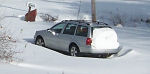
Snowy roadWith thanks to my Facebook friends for their contributions.
The smooth, quiet brush of fresh snow under your skis.
The way ice breaks and cracks over rocks as the tide falls.
Empty beaches with shimmering vistas.
Sea ice and rock, low tideThe mildness, softness and peace a snowfall brings.
Like the folks here, a winter is softness and gentility: quite well mannered, and departs when the welcome is worn.
Snow days!
A crackling fire in a woodstove making heat that penetrates to your bones.
A boy and a buoy
Walking ON the bay in places we usually row, paddle or sail.
Sunlight sparkling off snow-laden branches.
Minas Basin ice shifting, buckling, making strange sculptures on the shore.
Magnificent bald eagles.
Watching the days get longer in the coldest part of the winter.
Icing on the cakeShovelling the driveway with a helper who will clear up the last little bits: the sun.
NO mosquitoes, NO blackflies, NO no-see-ums!
The weather changes frequently: it’s fairly mild, and cold snaps are short, warm periods are also short. There’s something for everyone and no time to get bored!
The province is small but has a variety of microclimates. Want more snow? Ski hills are not so far away. Want less snow? Go walk a deserted South Shore beach.
Ice floes
Memories of crazy winter antics performed when we were young and immortal: descending hills at great speed, jumping from one ice floe to another as the frozen ocean broke up (some have memories of being rescued in these situations!), “getting towed on a sled behind my dad’s car on a snow-covered gravel road, riding my bike through the streets of Halifax when the snow wasn’t too bad,” ice boating, skating on thin ice….
Maple syrup made in the woods.
Alone in a drift
Patterns made by drifting snow.
Winter skies unlike anything you see in the summer.
Eating fresh snow.
Cardinals and purple finches at the feeder.
Getting insight into the life of rabbits from their tracks in the woods.
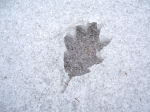
Oak leaf shape in iceSo there are some of the things we love about winter in Nova Scotia. What are yours? Leave a comment below.
Here is an organization I’m proud and happy to have joined – the Nova Scotia chapter of the Business Alliance for Local Living Economies.
Which makes me wonder, as a web designer, what is my contribution to a local, sustainable green economy?
Hmm… well, there’s the commute. Most of the time, I just head downstairs to my home office. No greenhouse gasses are generated. As the downstairs is heated with a radiant floor, it’s the warmest part of the house in winter. So that’s very efficient, but doesn’t quite qualify me as a green business – at least not until we get the planned solar panels up on the roof!
More to the point, however, my clients tend to be folks who operate independent, small (often micro) Nova Scotian businesses. They live and work here by choice, as do many Nova Scotians. It’s not always an easy choice. By running a successful business, however, they are helping others to live and work here as well. I’m happy to be part of that, and strive to contribute to their success. Some are in tourism, some are artists and craftspeople, some are lawyers and some are builders of log and timber frame homes.
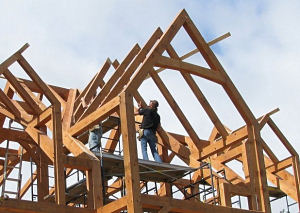
Arlington Frame Company raising a timber frame in Cape Breton
The timber framers in particular are quite aware that they add value to the forest simply by using wood for something more enduring than pulp fibre. Hardwoods such as oak and elm are prized by builders and their clients, as are large softwood trees such as pine. The companies that drive the clearcutting of the forests would rather eliminate the hardwoods with herbicides and harvest the faster-growing softwood trees for pulp.
Timber frame homes are built to last a long time. Their interiors are a celebration of the beauty of wood and craftsmanship. They are usually enclosed with energy-efficient materials. So they provide enduring value on many levels and make a solid contribution to the local living economy.
A visit to the Nova Scotia Museum of Industry in Stellarton made me realize how self-sufficient Nova Scotia used to be, from the growing of food to the manufacture of automobiles! It is a direction we need to move towards again. The reasons are both environmental and economic. A secure, local food supply and lower greenhouse gas emissions are part of it. And by supporting local businesses, we keep more money circulating in the local economy, and we all benefit.
So kudos to the people who started up BALLE-Nova Scotia for getting the balle rolling!
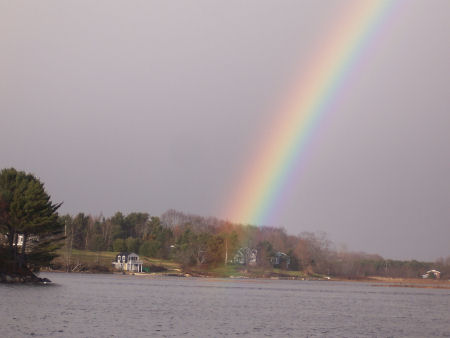
I was chasing rainbows again yesterday. So what exactly does the end of the rainbow look like? In this picture, the rainbow comes down in front of the trees and lands in the water. Actually, there used to be an island there; now it’s a shoal, where seagulls and cormorants like to roost. Someone, apparently, thought the Oak Island treasure had to be there, and dug up the island (which is located near Oak Island), looking for it. If there’s a pot of gold at the end of the rainbow, maybe he was right!
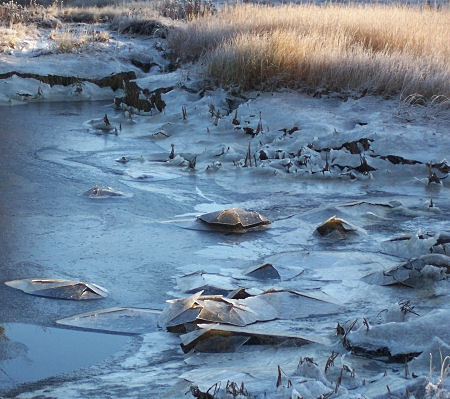
I’m fascinated by the formation of ice and how it interplays with the tides. And it has started again with cold morning temperatures which leave a layer of ice which plays with rocks as the tide goes down. You can hear the cracking as you walk along the shore – just little crick-clicks now, but bigger booms when the ice is thicker.
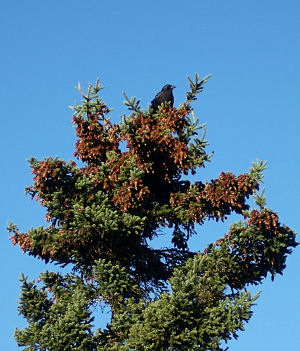
There is a traditional rule that says when the cones are set high in the trees, you can expect a lot of snow the following winter.
If it’s true, and if this tree in Feltzen South on Lunenburg Bay is reliable, then we’d all better make sure our snowblowers and plows are working, to say nothing of getting our backs in shape.
The crow in the picture is staking its claim over a reliable food supply. Crows are no fools.
So we’ll see what the winter brings. Remember, you saw it here first…