Staghorn Sumac Trees

I always thought of Staghorn Sumac as a bush, not a tree – until we moved to our present house, where two gorgeous Staghorn Sumac trees grace our yard. They are particularly beautiful in autumn.

The house is about 23 years old, and I presume the sumacs are around the same age.

Sumacs generally sucker like crazy: shoots come up from their roots and will grow as big as competition allows. But apparently, if you mow around the tree, allowing only one sumac stem to grow, it will grow to the height of a small tree, about 18′ (5.5m) tall. These trees still grow suckers, but they tend to appear some distance from the tree. Presumably they don’t grow as readily on older roots.

The leaves form an umbrella to catch the light. We have to prune them regularly along the driveway on their southeast side where the branches have grown too low.  Branches on the inside of the umbrella die off and break off easily.

The root system must be fairly weak, as both trees lean away from the direction of the strongest winds. One of them (not the one in the picture) reportedly toppled over in Hurricane Juan. The previous owner pulled it upright with his ATV. It still stands, but since it is getting harder to mow under it on one side, it must be gradually leaning more and more, like the Tower of Pisa before they fixed it.

I have successfully removed two other sumacs on the property by sawing them down and removing any shoots that appeared for a couple of years. So they are not too persistent.

Our sumacs are great climbing trees for young children, as the branches are low. Birds are also drawn to them for the seeds that grow in attractive fuzzy red spikes. The spikes stay on the tree all winter, making the sumac a most attractive tree year-round.

Lunenburg MLA Pam Birdsall reaches out with her website

Pam Birdsall in Canada Day parade

Just wanted to put in a plug for Lunenburg MLA Pam Birdsall and her website.

I first saw Pam years ago when we both had booths at the Nova Scotia Designer Crafts Council shows. Pam was a force behind that organization, as well as local business organizations and community groups like Second Story Women’s Centre, all while co-running Birdsall-Worthington Pottery Ltd. and raising a family.

Among her other legislative duties, Pam is chairing the committee to set up Arts Nova Scotia.

Pam would like her website to bring government and people closer together. Nova Scotia being a small and friendly place, its can happen.

Shakespeare by the Sea

Audience waiting for the show to start

Last week, we saw a wonderful production of Robin Hood by Shakespeare by the Sea. The company performs outdoors in Point Pleasant Park, unless it’s raining, in which case they have an indoor space available.

This year, the plays are staged at the Cambridge Battery, a set of ruined fortifications  in the middle of the park. You couldn’t invent such a backdrop. At intermission, kids of all ages explored the set, if only to see the view of the Atlantic Ocean beyond.

We were treated to great hilarity, exciting swordfights, intriguing a capella harmonies, endearing characters (yes you, Sven), modern cultural references, a classic storyline with a contemporary twist, and a professional ensemble cast. I highly recommend Robin Hood for anyone age 4 and up.

Even if you are unaccompanied by a child, you will enjoy the play!

The company is also performing two Shakespeare plays this summer: A Comedy of Errors and Measure for Measure. We hope to see at least one of them in the next two weeks. Their season ends September 4. See their site for showtimes.

If you’ve seen any of their productions this year, feel free to leave a comment.

Nova Scotia Summers

In the rain, because that's what you do.

My friend grew up in Ontario, but has lived in Nova Scotia for 10 years.

“I miss summer!” she said. “Where’s the heat?”

I thought about it, then laughed.

“I grew up in Nova Scotia,” I said, “and to me, summer is when you don’t have to put a coat on to go outside. When you aren’t fighting the temperature. When you don’t have to hide indoors. When you can embrace nature and it embraces you.”

It was her turn to laugh. “For you, summer is just when it isn’t winter!”

Tubing on the Gaspereau River

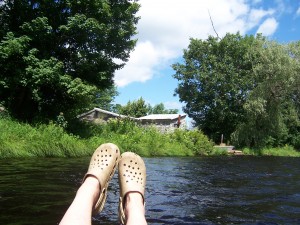
Feet and scenery
View from the tube.

Hey, there had to be a bright side to all that rain!

The Powers That Be have opened the gates above the Gaspereau River, raising the water levels in the river. Tubing is on again, which is rather unusual for August.

Carpe diem. We seized the day.

The water was higher than usual, and faster, which made for a more adventuresome experience.  I’m glad I didn’t try taking my camera on our second run downriver.

You can find Gaspereau River tubing on Facebook. Someone is keeping it up to date with current water levels.

River scene with boy in inner tube.
Floating to adventure

Summer Days at Hirtles Beach

It’s one of the South Shore’s favourite beaches, and it was a hit with our visitors from Ontario.

Playing in the waves at Hirtles Beach

The water was cold – but no matter. We had great fun body surfing.

In August, the sand is deep enough to bury a treasure.

A big kid digging at Hirtles with a big kid's shovel, August 2011

But come back in October, and you’ll find just rocks where there had been sand.

Hirtles Beach in October 2010. Not much sand.

Make play while the sun shines.

Flying a kite on sandy Hirtles Beach, August 2011

Two Planks and a Passion

In 1991, my father met a young couple on a train.

Dad was returning to Halifax after a post-retirement tour across Canada, and they were traveling from Toronto to Halifax, so there was lots of time to talk.

They wanted to start a theatre company in Nova Scotia — a “farm theatre”. He thought it was an interesting combination. Impressed, he suggested that either the Mosquodoboit Valley or the Annapolis Valley would be a good location.

The couple, Chris O’Neill and Ken Schwartz, chose the latter. In 1992, with little more than “two planks and a passion”, a grand vision, and large doses of talent and savvy, they set up a theatre company.

Two Planks and a Passion Theatre Company logoFor 15 years Two Planks and a Passion was on the road. They produced and toured relevant and memorable plays by the likes of Daniel McIvor and Drew Hayden Taylor. Just as often,  Ken and Chris penned their own plays, bringing to the stage Nova Scotian stories with broad relevance, such as The Butterbox Babies and Westray: The Long Way Home.

Meanwhile, Chris and Ken were raising a family that included twins. The demands of touring were making the dream of a farm theatre more and more appealing.

Finally the dream took root on an old farm at Ross Creek, on the North Mountain near Canning.

With Chris as Executive Director, The Ross Creek Centre for the Arts provides enriching experiences for working artists while training the next generation of artists. There are camps and other programs for kids and adults.  At the other end of the spectrum, the Centre provides opportunities for professional artists to retreat from the world and create, or to engage in unique ways with the community.

Two Planks and a Passion is now the Centre’s resident theatre company.  Each summer, under Ken Schwartz’s inspired direction, they create magical outdoor theatre “off the grid”, using the expansive landscape, original plays based on the classics with modern relevance, and some of the finest talent around.

This year’s Theatre off the Grid production is Beowulf, the ancient classic story re-imagined by Rick Chafe. It has garnered great reviews (and another). It is a strong production that left me in awe of the solidity of the acting, the direction and the story.

Beowulf is only playing until August 6th.  See it if you possibly can! Tickets are available here.


New power poles and our carbon footprint

Nova Scotia Power is bringing the power lines that march through the woods out to the road.

The lines will be easier to repair if they go down in a storm. And some waterfront properties will no longer have lines spoiling their view.

So we’re getting new power poles.

Nova Scotia Power workers and new power poles

Poles made from a variety of wood species are used. Some come from quite a distance. Near the water they put cedar from the west coast. Further inland they use creosote-treated pine from down the Eastern Seaboard where pine grows taller, straighter and faster. They also use Douglas Fir. Apparently the Nova Scotian pine that was once prized for masts of sailing ships by the Royal Navy is no longer good enough.

Something else to add to our carbon footprint.

“Why can’t they just bury the power lines?” you might ask. The answer, as for many questions about rural Nova Scotia, lies in the low population density. It just costs too much for the number of people who live here. So lines criss-crossing the road are just a fact of life in rural areas. We might as well embrace them, even photographically, like the fog!

The same factors that make Nova Scotia a wonderful place to live also determine its limitations. C’est la vie.

Halifax Jazz Festival is on

Strolling along the waterfront last Friday, we heard a cool jazz piano, accompanied by bass and drums, coming from the Festival Tent being set up on Lower Water St. at Salter St. extension. The place was crawling with volunteers adjusting banners and chairs, getting things ready for the show to start at 8 pm. They offered us a program, but, alas, we were on our way to see the Tattoo.

Setting up the Festival Tent for the Halifax Jazz Festival

The Halifax Jazz Festival continues until Saturday, July 16th in various venues around town.