And so the shoveling begins. We have about 3-4 inches of very dense snow here near Western Shore on the shore of Mahone Bay. A friend near New Germany, inland, reports at least a foot and a half of “thick heavy snow”. Meanwhile, someone in Kingsburg, which juts out into the Atlantic Ocean, has no snow at all! This pattern is typical: rain near the coast, snow inland.
Here’s how a tidal inlet on Mahone Bay looked this morning:
Jan. 13, 2011, after a snowstorm. Taken with a Fujifilm FinePix S1800 at the widest angle setting, equivalent to 28mm.
Sunrise this morning. Taken with a Fujifilm FinePix F1800 on a tripod.
Another storm is on its way. This one is the kind of blizzard you’d expect in January, with 10 to 15 cm (4 to 6 inches) of snow.
Atlantic Canada has been in the news lately with a series of storms in December, one week after another. If you just watched the weather channel you might think that we’re living in a disaster area and maybe that’s why I haven’t been posting frequently.
But where we live, we haven’t lost power for more than a minute, and we’ve escaped the brunt of the storms. The worst damage tends to be localized, and even though Nova Scotia is small, one side of the province often has very different weather than the other. Some weather systems track up the Bay of Fundy, for example, while others are phenomena of the Atlantic Ocean. And the Margaree Valley has received a lot of rain which seems to get trapped by the surrounding mountains.
The Annapolis Valley was hard hit by one storm which downed many trees, knocking out so many power lines that it took days to restore full service. Berwick United Church Camp, with its 500-year-old towering hemlocks, was badly hit, as was the Kentville Ravine which also has a stand of old growth hemlock. I’ve seen photos of damage in both places on Facebook. It is evident that some of the trees that came down were hollow and perhaps were near the end of their natural life. Thus the storm did what storms do: fell trees so that they can return to the soil and nurture new growth that will flourish in the sunlit openings they leave in their wake. Much as it feels tragic to those who love those trees – and I speak as one who grew up attending Berwick Camp every summer and loved its cool, shaded grounds and majestic trees – this is Nature’s way of renewing itself.
So we’ll take what comes – what else can we do? – and hope the power stays on.
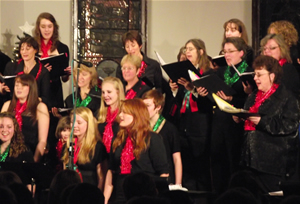
St. John's Lutheran Mother & Daughter Choir, taken from the back of the church with a Fujifilm FinePix F1800, which has an 18x optical zoom. This photo was taken hand-held, from the back of the church, and isn't even at full zoom.
Don’t ever imagine that life in the more rural parts of Nova Scotia is devoid of fine cultural experiences. In fact, there is more going on in many communities than a busy person can take in, and often it is all the richer for being home-grown.
Such was the case tonight when the St. John’s Lutheran Mother & Daughter Choir, directed by Leslee Barry, presented their Christmas Concert. The beautiful, large church was packed. No wonder: the music was very fine, with interesting, complex arrangements well executed, and very accomplished instrumentalists accompanying the choir. Much money was raised for the local food bank, and everyone went home satisfied, and in fine Christmas spirit.
Christmas concert in St. John's Lutheran, Mahone Bay, one of the "Three Churches". Taken at wide angle (28mm) with the Fujifilm FinePix S1800.
So much the better for knowing several people in the choir! That’s the human scale of life here in Nova Scotia.
House on Edgewater St., Mahone Bay, between the churches. I was impressed by how the S1800 could take pictures at high ISO settings (here ISO 800) allowing after-dark, no flash, no tripod photography like this.
The official Nova Scotia Photo Album calendar for 2011
Looking for a New Year’s gift? (That excuse will buy you an extra week.)
I’ve put together a calendar of photos from the South Shore of Nova Scotia. You’ll find it in my CaféPress Shop. Price is $19.99 USD.
Yes, it’s printed in the US on demand by CaféPress and ships from the US.
Your results may vary, but I haven’t had to pay duty on printed material (on paper) coming across the border from the US to Canada by mail, whether from Amazon or CaféPress. Clothing is another thing though, and mugs; I’ve had to pay duty as well as GST on those.
I’d love to hear of any CaféPress equivalents based in Canada.
One panorama from the Panoramas gallery. Click for more.
What to do when it’s pouring rain? Get new photos into the Nova Scotia Photo Album, of course. I just uploaded several new Panoramas and fleshed out the Annapolis Valley section.
Drive with me from Blockhouse through Cornwall to Cross Road, to Upper Northfield then left on Penny Road to Pinehurst, near New Germany, Lunenburg Co.
Many people were without power for a day or two due to trees and branches falling on power lines.
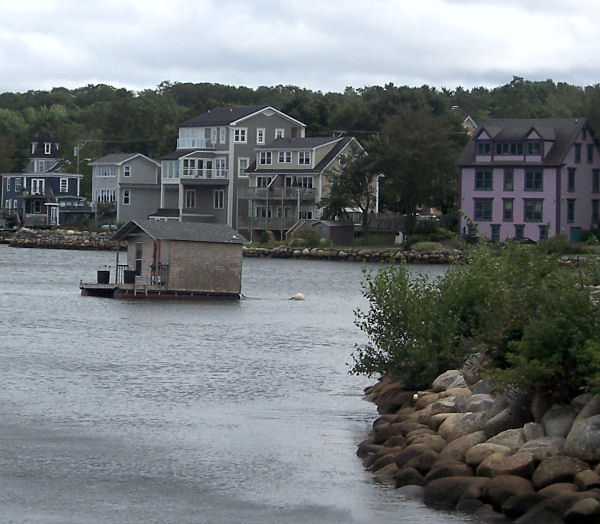
Damaged roller-reefing jib in Mahone Bay harbourOne of the two floating cabins in Mahone Bay harbour dragged its mooring inland.Who's the strongest of us all? This spider's web is battered but not broken.
Around noon, it brightened up, the wind died down and then shifted, and blue sky started to move in. We weren’t expecting a well-defined eye, but when we saw blue sky, we got excited.
Was it really the eye? Perhaps it was just the sky just clearing after the brunt of the rain had passed, because according to the storm’s dynamics, most of the rain was ahead of the eye.
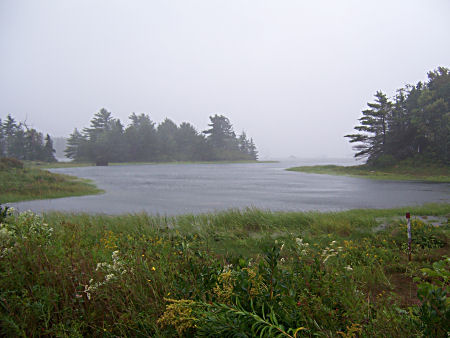
On this tidal inlet near Oak Island, it's supposed to be low tide at 11 a.m., but it looks more like high tide, due to the storm surge.
At 11 a.m., as the hurricane approaches, the powerful southeasterly wind is pushing water into the bay, causing a storm surge. We’re lucky that the tide is low. Otherwise, some coastal areas would be flooded and there would be damage to infrastructure.
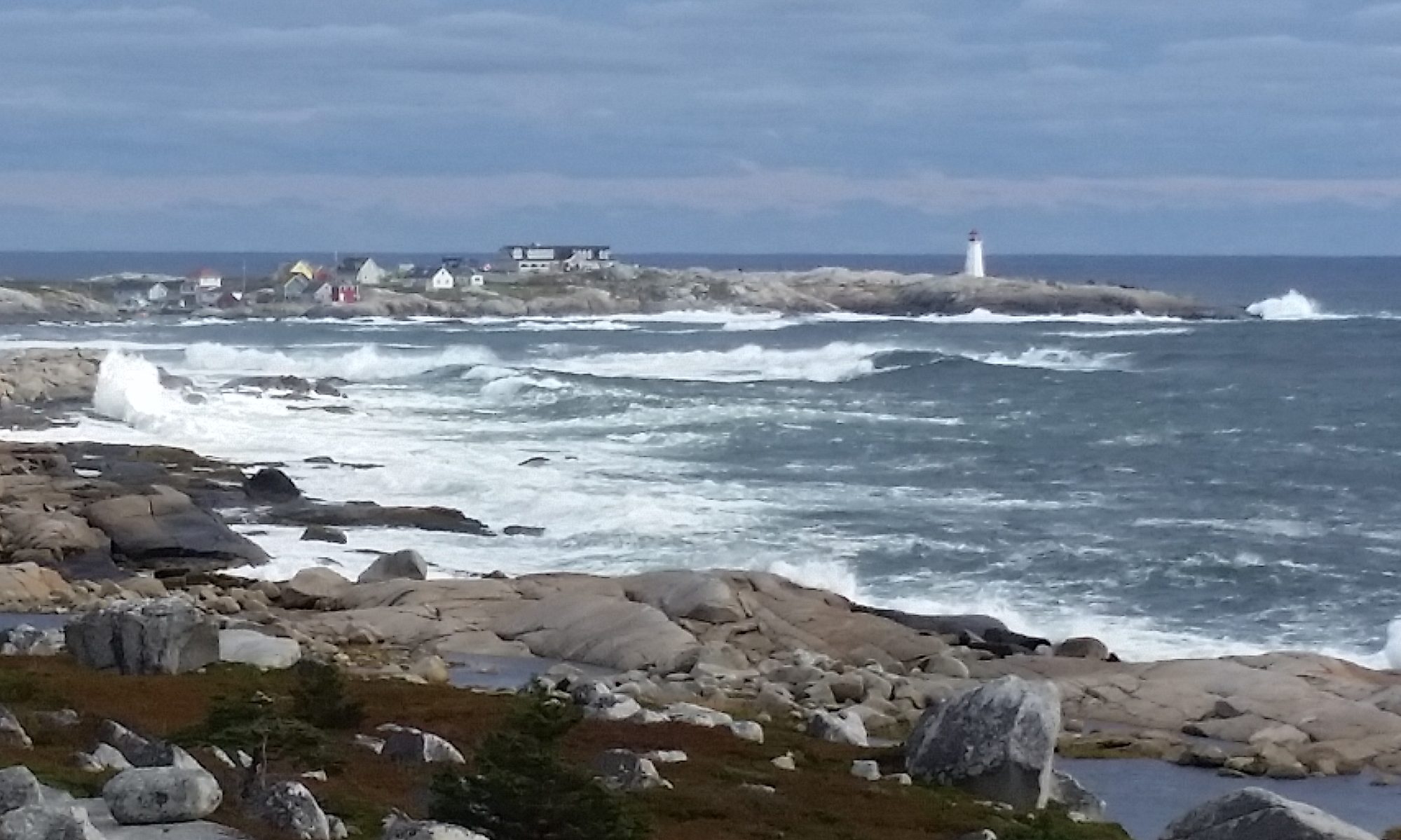
At Western Shore, surf’s up! This is usually a quiet and peaceful place, sheltered from the prevailing winds. But not today; the wind is coming right into Mahone Bay bringing the ocean with it.
Taken around 11 a.m. Wind is from the southeast. The centre of the hurricane is still to the south of Cape Sable Island and tracking northeastwards towards us at 30 mph (50 km/hr). Winds at nearby Lunenburg are reported to be SE 81 gusting to 99 km/h.