
Taken around 11 a.m. Wind is from the southeast. The centre of the hurricane is still to the south of Cape Sable Island and tracking northeastwards towards us at 30 mph (50 km/hr). Winds at nearby Lunenburg are reported to be SE 81 gusting to 99 km/h.
Hurricane Earl approaching Mahone Bay

We woke early to the sound of the wind, and the news that Hurricane Earl is tracking more easterly than predicted last night, and should pass us directly overhead. Right now it is just south of Yarmouth and has not made landfall yet.
Environment Canada calls it a marginal category 1 hurricane, though some other sources have downgraded it to a tropical storm.

The rain comes in waves.
I have fantasies of being able to photograph the eye if it passes overhead, but may not get blue sky behind. The satellite image doesn’t show a clear hole in the middle.
Ready and waiting for Earl

It’s a bit surreal preparing for a hurricane. If it weren’t for the weather forecasters and mass media, we’d have no idea that anything was coming. We take it on faith that they’re right, and act. We aren’t going camping or sailing this holiday weekend. Instead we’ve battened down the hatches and stocked up on cheese, and we’re waiting it out.
It looks like Earl will have been downgraded to a tropical storm before it hits Nova Scotia. We’re used to that. The colder water around Nova Scotia sucks the juice out of many hurricanes. But tropical storms can still pack quite a punch and cause damage, flood roads and unmoor boats. And occasionally a big one hits, like Hurricane Juan in 2003. So it’s best to be prepared.
Watching and waiting for Hurricane Earl
It is unusually hot here in this part of Nova Scotia (near Mahone Bay), for early September. Knowing that we’re going to be experiencing the eye of a hurricane before things cool down is not a great comfort, at least not when you own a boat.
Some people are taking their boats out of the water. Nearby, Oak Island Marina is asking boats with the greatest windage to leave the marina before the hurricane passes, whether to a “hurricane hole” such as Chester Back Harbour, or onto the land, to prevent damage to the marina and other boats.
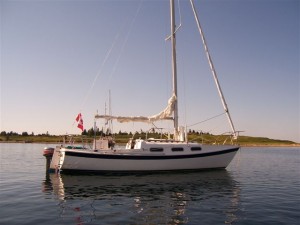
We have a strong mooring and a small, seaworthy sailboat (a Tanzer 22), and we still plan to do lots of sailing this fall. We will remove the sails to reduce windage, remove the outboard engine, secure or remove anything that could cause damage when bouncing around inside the boat, double up the mooring lines including a line from the mooring to the mast, and hope for the best.
If it weren’t so hot, this work would be easier.
Meanwhile, at home we have to be prepared for power outages and high winds, which means taking down the screened-in mosquito shelter, putting tools and toys away, filling the bathtubs and jugs with water, backing up my hard drive, and stocking up on food, batteries and camping gas. As long as the power stays on, I’ll report here on the storm as it passes.
A picture out of time
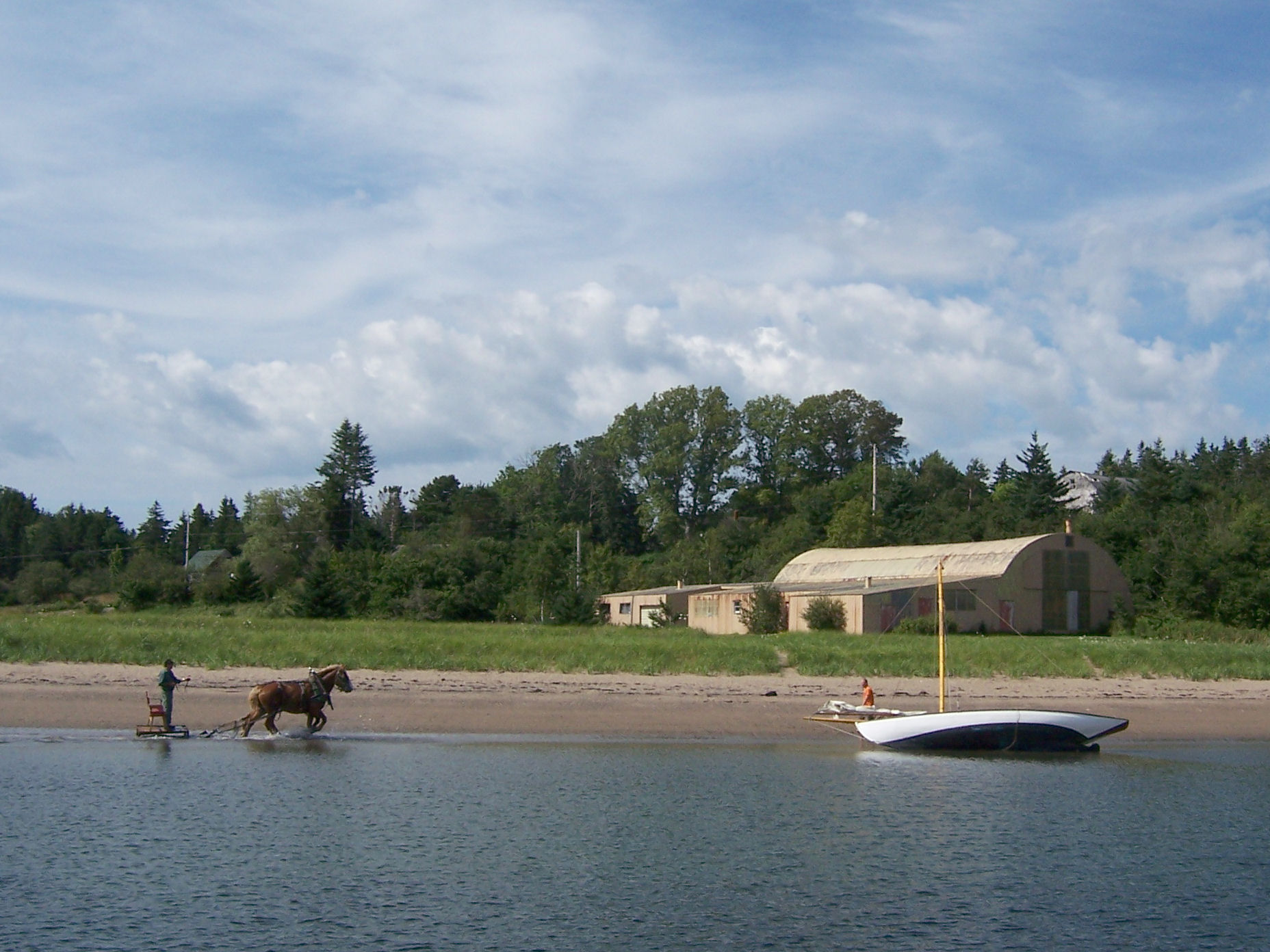
The wooden gaff-rigged sloop was on its way from Lunenburg to Mahone Bay. But the cable used to raise the centerboard had broken. So the sailor ran her up on Bachman’s Beach, on Second Peninsula, hoping to fix her at low tide.
The team of draft horses was in training, as usual, and was pulling a sledge. Their driver brings them down to the beach to cool off. We’d met them before, a couple of years ago, on this beach.
The hull of the sloop was built by David Westergard from a half-model he’d found. (Westergard is currently building a couple of schooners at the Dory Shop in Lunenburg.) Only after he’d built it did he learn that it was a particular Pubnico type of fishing vessel that was often fitted with a make-or-break engine. The sailor (whose name escaped me; add a comment if you read this) had rigged the boat himself and was bringing it to Mahone Bay for the schooner races.
“Are the schooner races part of Chester Race Week?” I asked, naively.
“Not at all.”
“Do the schooners eschew Chester Race Week?”
“Fiberglass Race Week!”
Right. The folks who perpetuate the skills of wooden boat building live in a different universe from the carbon fiber and kevlar world of the most serious racers. But they sail the same waters.
And so do we, on short overnight cruises in our 32-year-old fiberglass sailboat, not belonging to one group or the other, but glad to admire both, from a respectful distance.

Deer fence challenged by squash

A little more on the deer fence around my vegetable garden:
It’s really working very well, as far as the deer are concerned. The biggest challenge to it right now is the squash, which will go to any length to get through to the other side of the fence. There has been some damage to the netting, so I’ve either pruned the shoots that were trying to get through or directed them under the fence to the open lawn beyond.
Backcountry Camping in Kejimkujik National Park

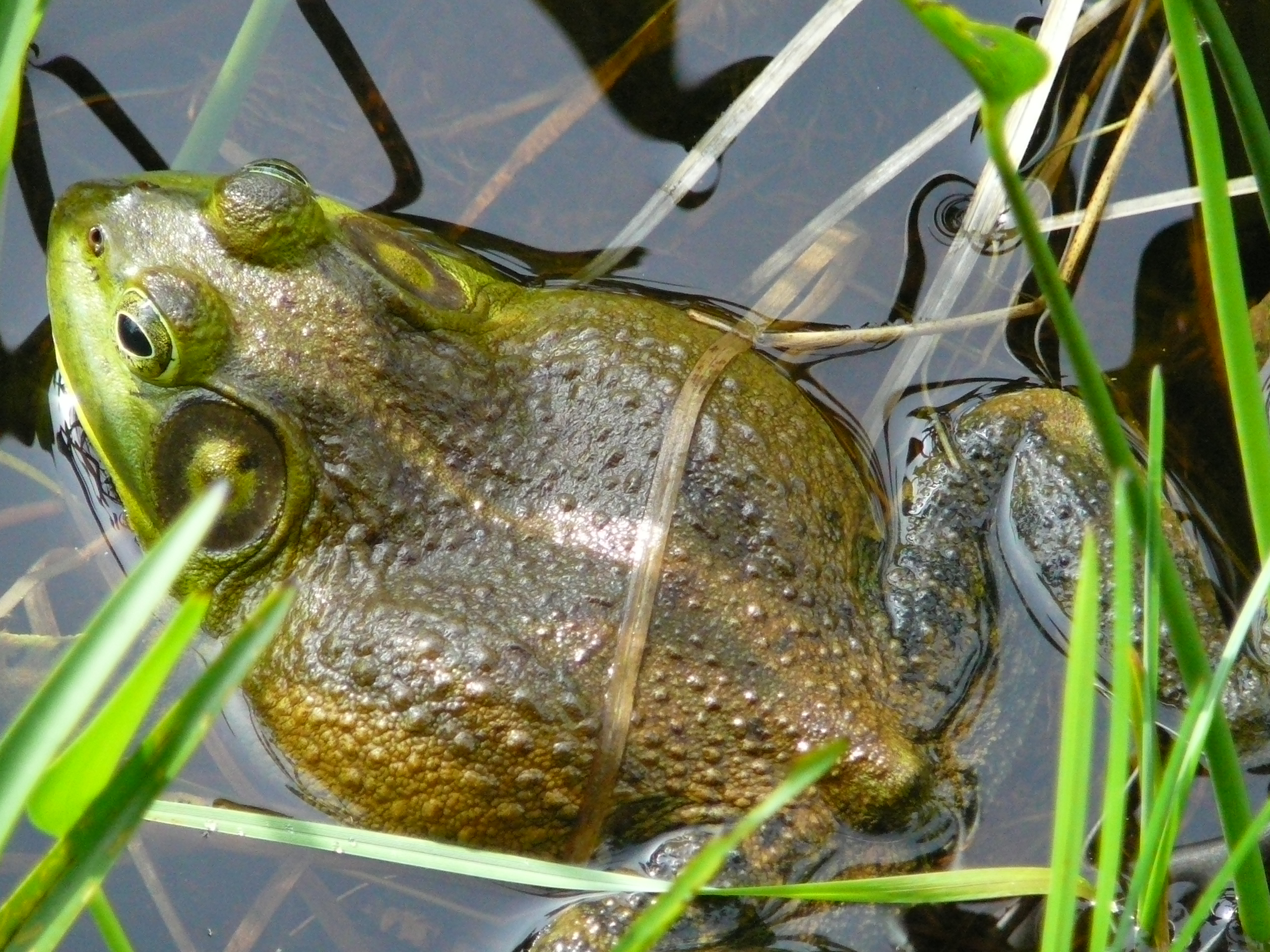
It was raining as we set up our tents on Big Muise Island in Kejimkujik Lake. Three days later, I had to bail rainwater out of the canoe as we paddled back to Jake’s Landing from Site 13 on Ritchie Island. In between, however, we had a couple of very pleasant days enjoying the warm water of the lake, the quiet forested islands, the wildlife – even the loud, musical bullfrogs that kept us awake at night – and, of course, our own good company and food.
Backcountry campsites can be booked 60 days in advance. For peak summer season, you really have to book that far ahead. So when the day comes, you go, rain or shine!

If you go:
Here is the Keji Park official site. It does not give a lot of detailed information. The next link is better.
Friends of Keji have a more informative and useful website.
Cartographer and photographer Paul Illsley has the best satellite map of Keji available with individual backcountry sites marked, and very fine photos of the park.
Finally, here you can download a Google Earth kmz file that will show the backcountry campsites on Google Earth. Very cool.
http://bbs.keyhole.com/ubb/ubbthreads.php?ubb=showthreaded&Number=412472&site_id=1#import
Deer fence around the garden

It’s not the ribbons of flagging tape that are keeping the deer out. It’s the almost invisible black plastic netting that the ribbons are hanging from.
It works – so far. This is my second year using it. (See previous post about the deer fence.) I regretted taking it down last fall, as it had been getting entangled in the grass, and removing it damaged the netting. But I’m gradually enlarging the vegetable garden and wanted to reset the netting. I have yet to see how well it will survive the winter.
There are different kinds of netting you can buy. The most lightweight is sometimes referred to as bird netting, with 1/2″ openings. It is easy to throw over strawberries or blueberry bushes, and it catches in the twigs easily, keeping it in place and making it hard to remove! It is very hard to see. One of us got it tangled in a lawnmower wheel and it took half an hour to cut it out. You can get it at a garden centre. If you’re in the US you can order from Amazon. [Easy Gardener 6050 DeerBlock 7-by-100-Foot Netting
The next level is what I bought at Lee Valley last year. It is a slightly heavier mesh, 7 feet high, with 7/8″ openings and reinforced margins top and bottom. (My 100-ft length didn’t go round the expanded garden this year, so I filled it in with some of the lighter-weight bird netting.) I pegged it down to the ground with twigs and it keeps the rabbits out, too. (I had a strange surprise, though, before pegging it down this year.)
This deer fence is not invincible. There are some tears in it that I need to fix. But we’ve seen a deer come up to it, and touch it with her nose, and go no further. My neighbour, who has come out on her porch to scare the deer away, has suggested attaching noisemakers to the fence.
Here’s an Amazon link (US only; they won’t ship this stuff to Canada) to a similar product: Easy Gardener LG400171 7-by-100-Foot Deer Barrier Fencing

Finally, there’s a much heavier gauge netting that I saw in a local hardware store. It was more expensive, but looks like it would last longer. It has 2 1/4 inch openings. If and when my current fence isn’t doing the job anymore, this is what I will get. Amazon link: Industrial Netting CXC90x100 Deer Net – 2.25 Inch Openings

The lightweight netting does not require strong posts. This year the garden was expanding, but I had no more of the aluminum posts that I put in last year, so I bought 8′ steel T-posts ($9 each) at the local farmers’ co-op store. They have pointed ends, but I would never be able to drive an 8′ post into the ground, so I cut one in half with a hacksaw, and pounded it 2 feet into the ground with a sledgehammer. (Thank you to my gardener grandfather from whom I’ve inherited all these tools!) After pulling the short post out, there was a T-shaped hole into which the tall post went in with just a bit of persuasion delivered from a stepladder. The rocks deep in the ground caused the post to be slightly askew, but that doesn’t really matter.
I’d love to hear from other gardeners about your experiences with animals in the garden – or with keeping them out.
International Fleet Review in Halifax
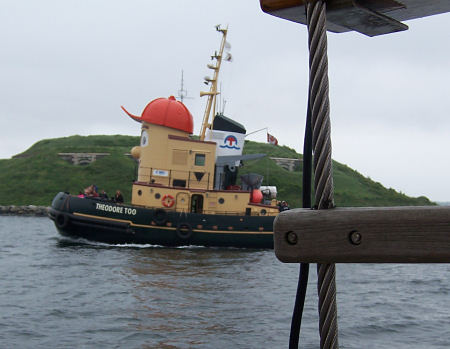
OK, Theodore Tugboat is not exactly representative of the Canadian Navy, but he was present during the international fleet review in Halifax Harbour on June 29, and so was HRM the Queen.
So also were my son, mother and stepfather (a former naval officer).
They snapped a few photos as they reviewed the fleet from the sailing ketch Mar II while the Queen did the same aboard HMCS St. John’s.

I’ve added a few of their photos to the Halifax section of the Photo Album.
Both the Queen (according to the Chronicle Herald) and my family (according to reliable sources) were given warm wraps by their respective ship’s crew to fend off the foggy chill.
The two groups came into close proximity later (see photo left).
I know that you wanna be Canadian
Hope this sticks in your head all day on Canada Day – whether you are Canadian or a wannabe.