Around noon, it brightened up, the wind died down and then shifted, and blue sky started to move in. We weren’t expecting a well-defined eye, but when we saw blue sky, we got excited.
Was it really the eye? Perhaps it was just the sky just clearing after the brunt of the rain had passed, because according to the storm’s dynamics, most of the rain was ahead of the eye.
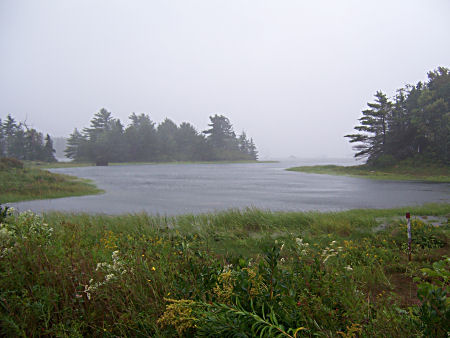
On this tidal inlet near Oak Island, it's supposed to be low tide at 11 a.m., but it looks more like high tide, due to the storm surge.
At 11 a.m., as the hurricane approaches, the powerful southeasterly wind is pushing water into the bay, causing a storm surge. We’re lucky that the tide is low. Otherwise, some coastal areas would be flooded and there would be damage to infrastructure.
At Western Shore, surf’s up! This is usually a quiet and peaceful place, sheltered from the prevailing winds. But not today; the wind is coming right into Mahone Bay bringing the ocean with it.
Taken around 11 a.m. Wind is from the southeast. The centre of the hurricane is still to the south of Cape Sable Island and tracking northeastwards towards us at 30 mph (50 km/hr). Winds at nearby Lunenburg are reported to be SE 81 gusting to 99 km/h.
Our T22 at 9 am near Oak Island causeway in Mahone Bay. Waves crash on the Marina's jetty in the distance.
We woke early to the sound of the wind, and the news that Hurricane Earl is tracking more easterly than predicted last night, and should pass us directly overhead. Right now it is just south of Yarmouth and has not made landfall yet.
Environment Canada calls it a marginal category 1 hurricane, though some other sources have downgraded it to a tropical storm.
Satellite image of Earl at 9:45 AT
The rain comes in waves.
I have fantasies of being able to photograph the eye if it passes overhead, but may not get blue sky behind. The satellite image doesn’t show a clear hole in the middle.
Extra lines from the mooring to the mast, just in case.
It’s a bit surreal preparing for a hurricane. If it weren’t for the weather forecasters and mass media, we’d have no idea that anything was coming. We take it on faith that they’re right, and act. We aren’t going camping or sailing this holiday weekend. Instead we’ve battened down the hatches and stocked up on cheese, and we’re waiting it out.
It looks like Earl will have been downgraded to a tropical storm before it hits Nova Scotia. We’re used to that. The colder water around Nova Scotia sucks the juice out of many hurricanes. But tropical storms can still pack quite a punch and cause damage, flood roads and unmoor boats. And occasionally a big one hits, like Hurricane Juan in 2003. So it’s best to be prepared.
It is unusually hot here in this part of Nova Scotia (near Mahone Bay), for early September. Knowing that we’re going to be experiencing the eye of a hurricane before things cool down is not a great comfort, at least not when you own a boat.
Some people are taking their boats out of the water. Nearby, Oak Island Marina is asking boats with the greatest windage to leave the marina before the hurricane passes, whether to a “hurricane hole” such as Chester Back Harbour, or onto the land, to prevent damage to the marina and other boats.
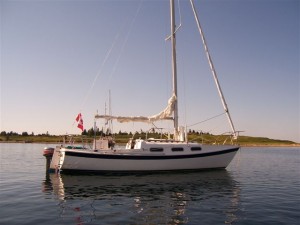
Tanzer 22
We have a strong mooring and a small, seaworthy sailboat (a Tanzer 22), and we still plan to do lots of sailing this fall. We will remove the sails to reduce windage, remove the outboard engine, secure or remove anything that could cause damage when bouncing around inside the boat, double up the mooring lines including a line from the mooring to the mast, and hope for the best.
If it weren’t so hot, this work would be easier.
Meanwhile, at home we have to be prepared for power outages and high winds, which means taking down the screened-in mosquito shelter, putting tools and toys away, filling the bathtubs and jugs with water, backing up my hard drive, and stocking up on food, batteries and camping gas. As long as the power stays on, I’ll report here on the storm as it passes.
I’ve been mesmerized by it out on the ocean on a sailboat, where it becomes your whole world – but that’s another blog post.
The other morning after the fog moved in, I was startled by the colours of the flowers. It was partly the contrast between the saturated colour close up and the grayed-out view in the distance. And partly (as photographers understand) the non-directionality of the light – the lack of shadows, so the colours are purer.
Apple blossoms, maple and birch in Lunenburg, May 13th
Apple blossoms were blooming in Lunenburg last Thursday, which means they’re past their prime in the Annapolis Valley already. The Apple Blossom Festival will apparently be blossom-less. Usually the organizers hit the blossoms right on with their timing, but this year it is generally agreed that spring is 2 to 3 weeks ahead of schedule.
Not that we’re complaining … this is my favourite time of year, when the leaves burst forth. If it’s part of a long-term trend, however, it could be very disruptive to the natural balance of blooming and birthing, migration and munching, which governs the ongoing survival of many animals and plants.
Spring is early across Canada, not just in Nova Scotia, or so I hear. Is spring early where you live? Leave a comment below.
After almost 3 weeks in Brussels and London (delayed by the ash cloud from the Icelandic volcano), I confess to having mixed feelings about coming home.
That’s because it’s really spring in Brussels. When we got there on April 4, the daffodils were past their peak. Forsythia – great bunches of it growing wild – was everywhere. The cherry trees on the streets were blooming pink, and along the highways were many white-blooming trees and bushes. The trees were just on the edge of leafing out when we left Brussels on April 19th.
Sure looks like daffodils and primula were growing wild on the forest floor in the Belgian Ardennes region, April 2010
Now at home, my daffodils have just started, and they’re early this year. I’d counted on this when we planned the trip: seeing two springs. And I will enjoy my second spring as much as the first.
So what is it about Nova Scotia that makes us put up with this extra month of not-quite-spring? And with the cold winters that would kill the broadleaf evergreens that keep Brussels green all year? That’s what I was asking myself as I went for my walk today.
And of course the answer is: the wildness of it. Nature raw and pure. Everything in Europe has been trod upon, cultivated, dug up and built over many times. There is hardly a river that follows its natural course through riverbanks that it carved itself. Humans have had their way with the land for thousands of years.
And we’re having our way with the land in Nova Scotia too, it’s just that we haven’t been here so long in such numbers. Natural shoreline is gradually diminishing, soils are being depleted, pollution locally-made or imported on the jet stream fills our lungs.
The closeness of the wild world reminds us that we still have something to protect, even while we seek to build a viable economy. Can we effectively, sustainably, balance these two concerns?