It’s a laborious but joyful spring chore for boaters in Nova Scotia: taking off the winter cover, cleaning her, fixing her up, painting her bottom, waxing her sides perhaps, and getting her ready to launch.
Owning a boat means using a lot of elbow grease, unless you’re wealthy enough to hire someone to do it all for you. And contrary to what you may think, boat owners aren’t all wealthy – partly because their boats keep them so. But the ability to get out on the water provides richness to their lives, whatever their bank balance may be.
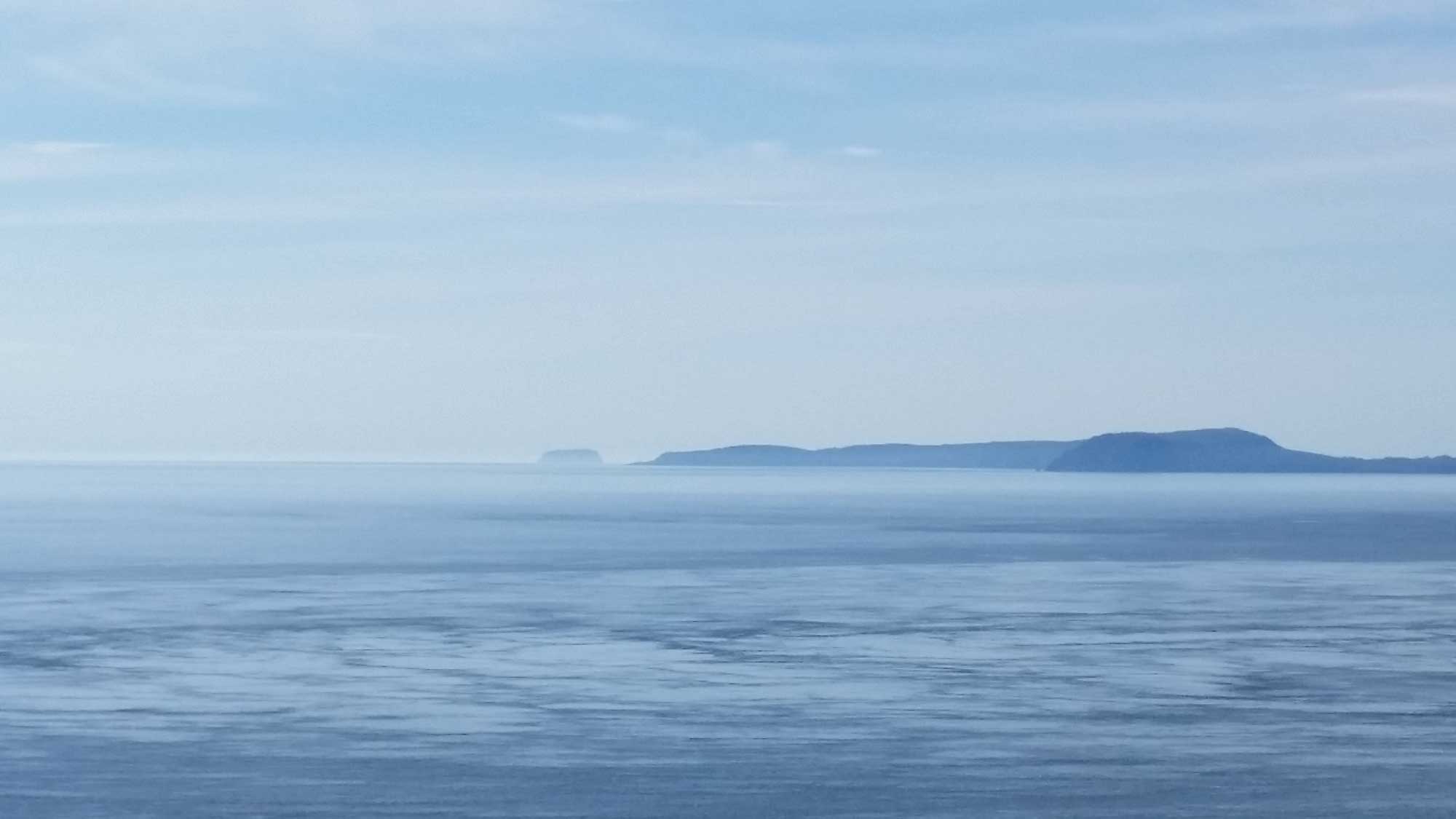
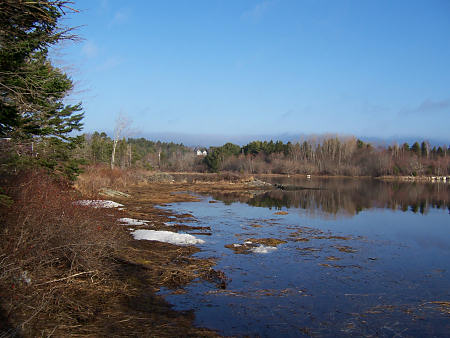
Imagine being a sailboat and spending the winter looking at this view. Wouldn't you be saying, "Let's go already!" come spring?
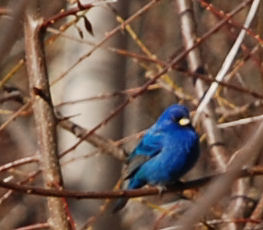
At first, the mysterious blue bird kept his distance.
Yesterday, Dennis Robinson, the Chickadee Dude (see our Chirbles the Chickadee pictures), spotted an indigo bunting, described by the Peterson guide as “casual” to Nova Scotia, in the Annapolis Valley.
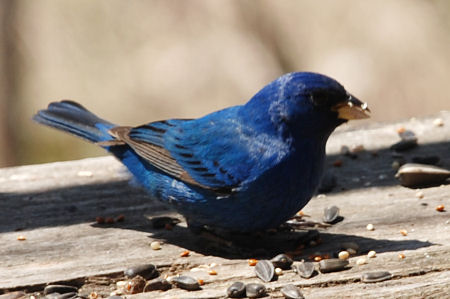
The startlingly blue-feathered bird watched the chickadees from afar. But finally, he decided that the chickadees had a good thing going and decided to check out some millet seeds (below).
This specimen is unusual in that his lower beak is light-coloured, rather than black as shown in the field guide.
Anyone else ever see an indigo bunting with a beak like this?
Indigo bunting eating millet seeds. Note the unusual lower beak.
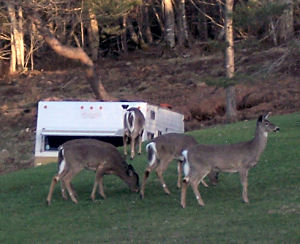
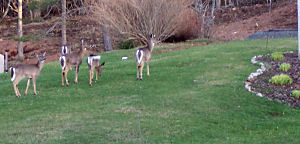
A bold group of white-tailed deer outside Mahone Bay
There is a neighbourhood outside the Town of Mahone Bay, on the road to Lunenburg, that is quite overrun with deer. We drove past it today and saw this group on a lawn. We were actually able to turn around and drive back to take pictures without them shying away.
Deer with hosta
Cute, you think? Only if you aren’t a gardener. Deer will eat tulips, blueberry bushes, the tops of potato plants and many other things one might like to grow – including roses.
Local nurseries will advise you on what is safe. Deer won’t eat daffodils, and don’t usually eat hosta, which is what the beleaguered owner of the garden in the second photo appears to be growing.
If you want to grow a serious vegetable garden, a tall fence is compulsory.
Deer ticks are endemic to the area, and they carry Lyme disease.
Sunny weather is forecast for the next week, with no temperatures below freezing. Time to plant some lettuce. Not for this bunny to eat, however (I hope).
Only a few weeks ago the rabbits I saw were quite white. This little fellow has his summer coat on now. He (or she?) looks quite delighted with the newly greening grass, or perhaps some delectible weed he has found. He was so busy, he didn’t notice me softly walking up the driveway.
Blue jay flies across the lawn
How quickly comes spring, when it finally comes. Perhaps even the word “spring” comes from the same root as the kind of spring found in a mattress. All that life energy is compressed, cowering under winter’s weight, until winter rolls away off the bed and, suddenly released, Spring bursts forth to exuberantly express itself … Boing … like a rabbit’s hop when it realizes you’re there.
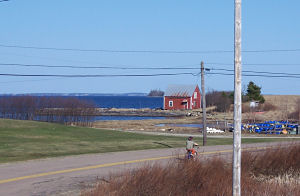
A beautiful day begs a bike ride. We headed for Martin’s Point, which sticks out into Mahone Bay between Oak Island and Indian Point.
Martin’s Point points towards the many Mahone Bay islands that we like to sail to and around.
Older homes on Martin's Point
Like many coastal areas, it has a mixture of century-old homesteads, decades-old bungalows, and some new, modern, expensive homes that the average Nova Scotian can not afford, often built by come-from-aways as a summer home and a place to retire.
People who move here by choice bring a lot to our communities – financial resources, income for local businesses, support for the arts, etc. There is often a conflict in values and lifestyle between them and the local population, however, who have a different sense of belonging to the place and a history that goes back generations.
Seagull and Great Blue Heron on Martin's Point
The result can be tension between groups with different priorities, as we have seen in the Town of Mahone Bay over the issue of whether or not to “develop” the woods and soccer field near the old school which is now a community centre. I could go on.
Meanwhile, it was a sunny Saturday and we enjoyed the peaceful bike ride on Martin’s Point. Not a single car asked to share the road with us.
I’ve just set up a new section of the photo album called “Chirbles the Chickadee, his Friends and his Enemies”. It features the nature photography of the “Chickadee Dude”, Dennis Robinson. He has a special relationship with his chickadees and loves to capture their personalities with his camera.
Some of these photos of Nova Scotia birds are available on various products such as postcards and notecards in our Nova Scotia Gift Shop. Look for Chirbles.
Song sparrow blends in with the salt marsh grass by the shore.
It was a beautiful morning laced with frost which disappeared quickly. The birdsong was joyous, and made me wonder what it was like when the world was young, before DDT and all, when the birds’ habitat was their own.
A song sparrow (right) was hopping around by the shore, blending in with the grasses.
Sparrow at the edge of the woods near the house.
I saw another song sparrow (I think) at the edge of the woods (left). Neither bird was singing, though. They were too busy, I suppose, and didn’t want to advertise their presence on the ground where they are more vulnerable.
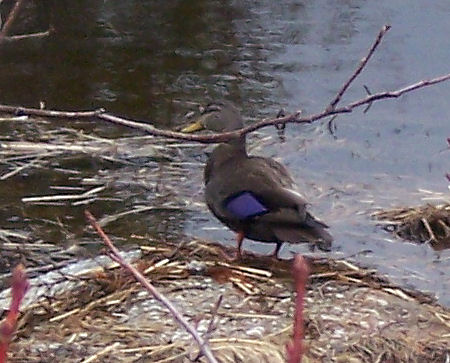
Perched on a rock at high tide, a female blue-winged teal
Another duck in our local collection, alongside American black ducks, mallards and buffleheads. I wouldn’t ordinarily get such a photo, but there was a bush between us and the duck was preoccupied, I suppose. The tide was very high, flooding the marshes. It’s duck country.