Extra lines from the mooring to the mast, just in case.
It’s a bit surreal preparing for a hurricane. If it weren’t for the weather forecasters and mass media, we’d have no idea that anything was coming. We take it on faith that they’re right, and act. We aren’t going camping or sailing this holiday weekend. Instead we’ve battened down the hatches and stocked up on cheese, and we’re waiting it out.
It looks like Earl will have been downgraded to a tropical storm before it hits Nova Scotia. We’re used to that. The colder water around Nova Scotia sucks the juice out of many hurricanes. But tropical storms can still pack quite a punch and cause damage, flood roads and unmoor boats. And occasionally a big one hits, like Hurricane Juan in 2003. So it’s best to be prepared.
It was raining as we set up our tents on Big Muise Island in Kejimkujik Lake. Three days later, I had to bail rainwater out of the canoe as we paddled back to Jake’s Landing from Site 13 on Ritchie Island. In between, however, we had a couple of very pleasant days enjoying the warm water of the lake, the quiet forested islands, the wildlife – even the loud, musical bullfrogs that kept us awake at night – and, of course, our own good company and food.
Backcountry campsites can be booked 60 days in advance. For peak summer season, you really have to book that far ahead. So when the day comes, you go, rain or shine!
Site 13, Kejimkujik National Park.
If you go:
Here is the Keji Park official site. It does not give a lot of detailed information. The next link is better.
Lee Valley plastic mesh with ribbons of flagging tape woven in
It’s not the ribbons of flagging tape that are keeping the deer out. It’s the almost invisible black plastic netting that the ribbons are hanging from.
It works – so far. This is my second year using it. (See previous post about the deer fence.) I regretted taking it down last fall, as it had been getting entangled in the grass, and removing it damaged the netting. But I’m gradually enlarging the vegetable garden and wanted to reset the netting. I have yet to see how well it will survive the winter.
There are different kinds of netting you can buy. The most lightweight is sometimes referred to as bird netting, with 1/2″ openings. It is easy to throw over strawberries or blueberry bushes, and it catches in the twigs easily, keeping it in place and making it hard to remove! It is very hard to see. One of us got it tangled in a lawnmower wheel and it took half an hour to cut it out. You can get it at a garden centre. If you’re in the US you can order from Amazon. [Easy Gardener 6050 DeerBlock 7-by-100-Foot Netting]
The next level is what I bought at Lee Valley last year. It is a slightly heavier mesh, 7 feet high, with 7/8″ openings and reinforced margins top and bottom. (My 100-ft length didn’t go round the expanded garden this year, so I filled it in with some of the lighter-weight bird netting.) I pegged it down to the ground with twigs and it keeps the rabbits out, too. (I had a strange surprise, though, before pegging it down this year.)
This deer fence is not invincible. There are some tears in it that I need to fix. But we’ve seen a deer come up to it, and touch it with her nose, and go no further. My neighbour, who has come out on her porch to scare the deer away, has suggested attaching noisemakers to the fence.
Finally, there’s a much heavier gauge netting that I saw in a local hardware store. It was more expensive, but looks like it would last longer. It has 2 1/4 inch openings. If and when my current fence isn’t doing the job anymore, this is what I will get. Amazon link: Industrial Netting CXC90x100 Deer Net – 2.25 Inch Openings
The lightweight netting does not require strong posts. This year the garden was expanding, but I had no more of the aluminum posts that I put in last year, so I bought 8′ steel T-posts ($9 each) at the local farmers’ co-op store. They have pointed ends, but I would never be able to drive an 8′ post into the ground, so I cut one in half with a hacksaw, and pounded it 2 feet into the ground with a sledgehammer. (Thank you to my gardener grandfather from whom I’ve inherited all these tools!) After pulling the short post out, there was a T-shaped hole into which the tall post went in with just a bit of persuasion delivered from a stepladder. The rocks deep in the ground caused the post to be slightly askew, but that doesn’t really matter.
I’d love to hear from other gardeners about your experiences with animals in the garden – or with keeping them out.
Snapping turtle laying eggs by the side of the road, Upper Northfield, Lunenburg Co., June 24, 2010
This cannot be a good survival strategy.
Snapping turtles lay eggs in June and July uphill from a water source. This snapper has found some gravel right by the side of the road, a foot or two from the pavement. The water source, as you can see in the picture, is a human-excavated pond some distance away.
I wonder if this snapping turtle has tuned into her ancestral memory. Perhaps, before the road was developed, her mother laid her eggs in a sandy bank here, and when my friend emerged from the egg, she scampered and tumbled down the hill to the embracing water in a natural stream or that once flowed quietly just below this very spot.
Now she is laying her eggs in gravel that has been brought in to elevate and level out the road. If the eggs don’t dry out in the gravel and hot sun, or get squashed by a truck parking on top of them, her hatchlings will have to reach the artificial pond in the distance in order to survive and thrive.
Trying circumstances, it seems to me, and not unsimilar to those facing many young members of a much more recent species on this planet, homo sapiens.
So yesterday I put up the deer fence around the garden. I didn’t get around to pegging the bottom of the netting to the soil, but did bravely transplant my broccoli.
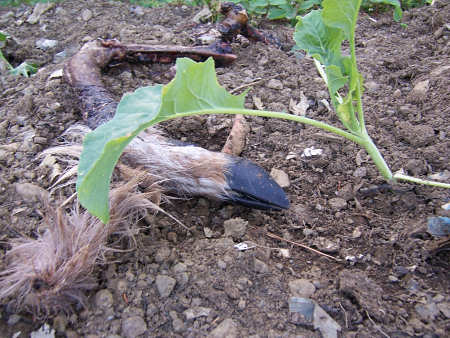
This morning when I went to check on my baby brassicas, I was very surprised to see the leg and hoof of a deer lying next to my tender greens!
The leg of a deer in my garden, next to the broccoli.
There was no sign of damage, and no clear tracks that would help me identify who brought in this offering. It obviously wasn’t a vegetarian, as there had been no nibbling on the luscious leaves. And it couldn’t have been a very large animal.
What an ironic reminder that despite my efforts, I’m not totally in charge here, and the deer will get into my garden one way or another, dead or alive!
Update: I found a tear in the netting on the other side of the rhubarb that could have been from the stress of a raccoon, perhaps, pushing its bulk under the netting by the broccoli. There has also been a fox around, who may have wanted to bury the leg, and was attracted by the freshly-dug earth. I should think that a raccoon would have done more damage.
Apple blossoms, maple and birch in Lunenburg, May 13th
Apple blossoms were blooming in Lunenburg last Thursday, which means they’re past their prime in the Annapolis Valley already. The Apple Blossom Festival will apparently be blossom-less. Usually the organizers hit the blossoms right on with their timing, but this year it is generally agreed that spring is 2 to 3 weeks ahead of schedule.
Not that we’re complaining … this is my favourite time of year, when the leaves burst forth. If it’s part of a long-term trend, however, it could be very disruptive to the natural balance of blooming and birthing, migration and munching, which governs the ongoing survival of many animals and plants.
Spring is early across Canada, not just in Nova Scotia, or so I hear. Is spring early where you live? Leave a comment below.
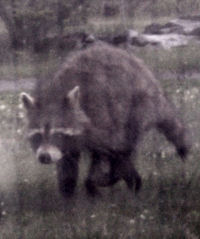
Photo taken in a hurry through the screened basement window.
Like the fox last week, this raccoon came up the road from Oak Island, saw the houses up ahead and decided the woods behind our house were a better bet.
In six years of living here, it’s the first raccoon I’ve seen.
A neighbour told me he saw a black bear just down the road about five years ago. He figures it was just passing through, as he hasn’t seen or heard tell of one around here since.
But over 1000 black bears were killed by registered hunters in Nova Scotia in 2009. So they are around.
The 2009 deer harvest in Lunenburg Co., which has been increasingly plagued by deer ticks in recent years, was the highest in the province: 3,104. Many gardeners will be relieved to hear this news. But it won’t stop me from putting a deer fence around the garden again. I recently saw 4 or 5 white-tailed deer in our backyard.
Department of Natural Resources personnel examine roadkill to see what shape the animals are in. In the winter of 2008, they found that a high proportion of deer were experiencing malnutrition and starvation. So the 10,280 deer bagged by hunters across the province was less than the previous year, according to the Truro Daily News, as fewer permits were issued to hunters for antler-less deer.
We get a lot of wildlife where we live, but this was our first sighting of a fox. It came down the road, crossed our front yard and disappeared into the woods. I was lucky to get a photo at all. My husband saw it later the same morning, going the other way.
After almost 3 weeks in Brussels and London (delayed by the ash cloud from the Icelandic volcano), I confess to having mixed feelings about coming home.
That’s because it’s really spring in Brussels. When we got there on April 4, the daffodils were past their peak. Forsythia – great bunches of it growing wild – was everywhere. The cherry trees on the streets were blooming pink, and along the highways were many white-blooming trees and bushes. The trees were just on the edge of leafing out when we left Brussels on April 19th.
Sure looks like daffodils and primula were growing wild on the forest floor in the Belgian Ardennes region, April 2010
Now at home, my daffodils have just started, and they’re early this year. I’d counted on this when we planned the trip: seeing two springs. And I will enjoy my second spring as much as the first.
So what is it about Nova Scotia that makes us put up with this extra month of not-quite-spring? And with the cold winters that would kill the broadleaf evergreens that keep Brussels green all year? That’s what I was asking myself as I went for my walk today.
And of course the answer is: the wildness of it. Nature raw and pure. Everything in Europe has been trod upon, cultivated, dug up and built over many times. There is hardly a river that follows its natural course through riverbanks that it carved itself. Humans have had their way with the land for thousands of years.
And we’re having our way with the land in Nova Scotia too, it’s just that we haven’t been here so long in such numbers. Natural shoreline is gradually diminishing, soils are being depleted, pollution locally-made or imported on the jet stream fills our lungs.
The closeness of the wild world reminds us that we still have something to protect, even while we seek to build a viable economy. Can we effectively, sustainably, balance these two concerns?
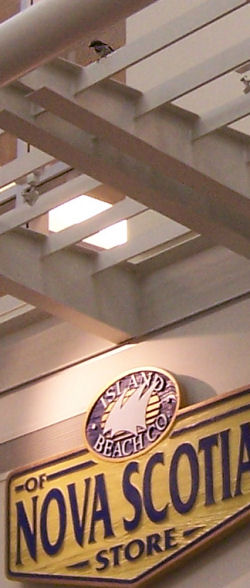
Sparrow looks down from rafters in the main atrium of Stanfield Halifax International Airport
If you’re bored in Halifax Stanfield International airport, you can always watch the birds in the central atrium. They’ll be watching you anyway. The atrium is full of cheerful chirping. There’s a sign that asks you not to feed the birds, so apparently their presence is intentional.
These aren’t pigeons or ducks that walk around on the floor; they’re little songbird types, and they mostly fly from rafter to rafter way up. If no one’s around they’ll swoop down to the level of the tropical plants behind the benches.
Next time (especially if I’m just picking someone up), I’ll bring my binoculars. The only one I saw close enough to identify was a house sparrow. But they aren’t all house sparrows, that much I could tell.
So, does anyone know about the birds in the airport, how long they’ve been there and what species they are?



 ]
]