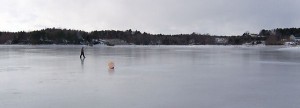
We’ve had quite a long cold snap, and the ocean ice in and near our inlet is way over 6 inches thickness, the recommended thickness for safety. Beautifully smooth too, in places, though the wind chill discouraged us from going back for our skates.
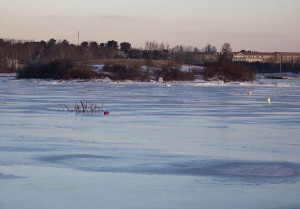
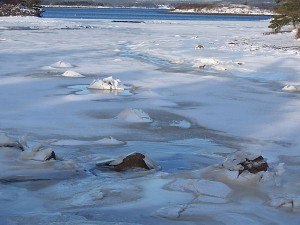
A branch which has been stuck in the ice for weeks now, next to a mooring buoy, with other moorings in the backgroundWe walked out to a small island and explored the ice formations around the rocksAlong the shoreline at low tide, a weird and wonderful landscape to explore
At low tide, the ice is sitting on or near the bottom, so there’s little risk. It’s harder to get onto the ice when the tide is higher, as the broken pieces around the edge may not bear one’s weight, as my son learned this morning! No harm done, just wet boots and an uncomfortable trot home.
The big rocks in the middle are barely underwater at high tide, and we have to avoid them when rowing or paddling in the summer.
Ice always builds up and stays in the inlets where it isn’t easily carried out to sea. At low tide it just sits on the bottom, on the mud. There’s always a dynamic edge out there forming, melting, breaking off depending on the wave action, with pieces getting carried out to sea.
The water's edge, tide rising after a cold nightThe ice that was shaped by this rock and then broke as the tide fell tide now floats over it on the rising tide.
I tasted the ice that had formed at the water’s edge on a small beach, as I said I would. As predicted, it was indeed fresh, not salty. A good survival tip, should you ever find yourself shipwrecked on a desert island in winter.
People are sometimes surprised to learn that ocean water can freeze (but think about it: we’re worried about the melting polar ice cap). Two winters out of the last four, we’ve been able to skate on Mahone Bay after a really cold snap. Salt water freezes at a lower temperature than fresh water, and the saltier it is, the colder it has to be to freeze. I’ve found that it has a softer quality than freshwater ice, perhaps because of the impurities it would contain. But I’m sure it’s just as unforgiving if you crack your head on it!
I’ve always found crystals fascinating. In my days as a lab chemist I enjoyed doing crystallization, which is done in the lab as a means of purifying a substance. That’s because a crystal is formed when the molecules of a substance lock together in a close pattern. There isn’t much room for anything else in there, between the molecules. Separate the crystals from the rest, and you’ve got a pretty pure product.
Ice on a rock as the tide recedesThis morning there were water crystals forming in quiet corners of the bay. They are supposed to contain very little salt. (Next time I’ll try tasting some!) When salt water freezes on the surface, the ice is relatively fresh (i.e. not salty). Polar bears are observed (not in Nova Scotia!) drinking from puddles on ice floes. Meanwhile, the water beneath the ice gets saltier – and denser, sinking – which makes it even less likely to freeze.
Of course, these ice crystals I saw this morning melted during the day.
I wonder what the ducks are finding to eat in the flooded marsh? At high tide, a dozen of them will be gathered around one spot, head and neck down in the ooze. Is it some small semi terrestrial creature that gets flooded out when the tide is so high? Does anyone know?