Of right, privilege and freedom

I woke up this morning with my family aboard a sailboat at a peaceful anchorage in Mahone Bay just a couple of hours sail from home.  And shared my thoughts:  “We are so privileged to be doing this.  Not just having the boat, but to be able to sail where we want and drop the anchor where we deem best, want without paying a toll to anyone, and to enjoy this beautiful scenery so freely.”

Sunset at Covey Island, one of the islands protected by MICA.

The first settlers of Lunenburg must have been in awe at such freedom.  What we now call Germany was at the time an assortment of many principalities of various sizes.  Going down the “highway” of the river Rhine to Rotterdam, where they boarded the ship that would take them across the Atlantic, the emigrants would have been stopped at every border crossing and paid tolls.  Many of them had even needed to secure permission from their feudal lord to leave the land they were bonded to as peasants.  Once they reached Lunenburg in 1753, they must have been very appreciative of the freedom to profit from their own labour and build their future with their own hands.

Even some of the modern-day German immigrants to Nova Scotia that I know have expressed to me their appreciation of the freedom they have here in a society that is less regulated than the one they left behind.
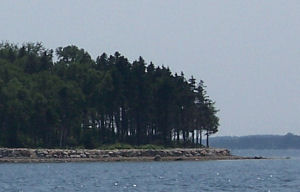
The entire natural coastline of this island has been destroyed and replaced with a rock wall.

The Mahone Islands Conservation Association (MICA) works to protect public access to the islands of Mahone Bay, as well as to preserve their natural environment.  The islands are increasingly under pressure by private owners and developers.  Natural shorelines and nesting habitats are disrupted (photo right).  Owners of some islands chase visitors off beaches that have long been used by the general public. (Some have been known to brandish guns in their efforts, something  that Canadians or at least Nova Scotians just don’t do.)

From what I understand, depending on the type of deed, the intertidal zone has legally remained public except in a few cases where water rights were transferred.  In a country where travel by boat was the norm, the right to land on a shore would have been an issue of public safety.  Nowadays, it seems that there is a trend for private property rights to be extended into the intertidal zone –  whether by deed, by custom, by complicity of the authorities or by ignorance by the public, I don’t know.  Enlighten me if you know anything more about this issue, please, by commenting below.

Meanwhile, I take pleasure in seeing the decendants of the original Lunenburg settlers, with names such as Meisner and Ernst,  involved in MICA, perserving public access to the islands of Mahone Bay for future generations of humans and seabirds.

Larinda rises again

Larinda's figurehead frog in a new coat of paint

The highlight of the Tall Ships visiting Lunenburg was seeing Larinda. She’s a replica of a 1767 schooner, built over a period of 26 years by Larry Mahan of Barnstable, Mass.  She was a labour of love, full of wood carvings and fancy and fun. Mahan sailed her in many Tall Ships events, where she was much admired. Then in 2003, having taken shelter in Halifax Harbour during Hurricane Juan, she was rammed by another ship during the storm and sank, right next to a sewerage outlet. It was a big mess, and Mahan despaired of ever being able to repair her.

Larinda's stern, reflected in the water
Larinda's stern, reflected in the water of Lunenburg Harbour

The salvaged boat was bought by a Nova Scotia couple who live on St. Margaret’s Bay, and is being carefully restored.  Larinda didn’t actually make it to the Halifax Tall Ships event, and hasn’t been fully rigged yet. But she was towed to Lunenburg and rafted up alongside the schooner Unicorn, from whose deck we could admire her. Larinda is sporting a new colour scheme of black, white and bronze instead of green and off-white (see photos of Larinda before the sinking).  Her distinctive red battened junk sails were irreparably damaged, and her new sails will be white. The frog in the tricorner hat still graces her bow, and her brasswork is shiny.

Larinda truly is a special ship.  It will be exciting to see her sail again.

Larinda's deck, with graceful carvings, is being restored.

Derek Hatfield sails again

Derek Hatfield and Spirit of Canada, with some mutual friends, in Halifax Harbour
Derek Hatfield and Spirit of Canada, with some mutual friends, in Halifax Harbour. Photo by Ed Sulis.

Canada’s Derek Hatfield (who makes his home in Mahone Bay, Nova Scotia), was forced to retire from the Vendée Globe round the world, non-stop solo sailing race in December, due to damage to his boat.  He nursed his Algimouss Spirit of Canada to Hobart, Tasmania, where he fixed the damage, and on February 27, he left Hobart, determined to complete the course of the race, even if he is no longer officially in it.  Thus he will gain valuable solo experience and the knowledge of his Open 60 equal to that of anyone who completes such a race.  He will not get the support from the race organizers that he would have had were he still in the race.  However, he will be sailing along parts of the route in the company of some other major offshore races.

The Vendée Globe is gradually wrapping up with the final three boats now in the North Atlantic and due to reach France in the next couple of weeks.

Fair winds, Derek.  Hope to see you back home safe and sound in a couple of months!

Lunenburg in the glorious winter sunshine

I had to go to Lunenburg today to see a client, and afterwords I walked around and took pictures.  Twas the kind of day that puts smiles on people’s faces.

I’ve just added several of today’s photos to the Lunenburg page of the Photo Album.  I love Lunenburg – the steep hills overlooking the harbour, its history, the generations who have lived there.  It’s special.

St. John's Anglican Church and Lunenburg harbour beyond

Momentous events leave nature cold?

After yesterday’s grand celebrations in Washington, and us watching on TV with much of the rest of the world, the ice and the sea were still there this cold morning.  The frigid air knew nothing of rarefied oratory or high expectations, of the helicopter that had spun a departing president into the sky, and the ice had not heard of the new one – the president of the world, no less –  who magically came into power at precisely noon while listening thoughtfully to Itzhak Perlman and Yo-Yo Mah’s divine music.  The ice floating on the sea, like the air suspended above it, just was.

Ice floating on the tide, January 21, 2009

But if a butterfly flapping its wings can alter events far away in space and time, perhaps this ice is not exactly the same as it would have been had yesterday been less auspicious.  And if we cannot observe things without changing them on some microscopic level, then because I am thinking these thoughts, the morning has been made different just by my presence, by the same mechanism that Barack Obama’s inauguration has changed the world.

I am reminded of a woman I met in a Nigerian market who spoke of how much better life had been under the brief regime of a certain president a few years before. She said that in those days, “I would go home from the market and make better soup.”  Seasoned with a dash of optimism and happiness, the flavour of ordinary, mundane ingredients can actually be improved.

Lastly, I recall reading some time ago how the culture of government in the US had spawned a sort of anti-intellectualism: it wasn’t cool to be smart.  Is that like the old custom of not standing higher than the king?  Let’s not be smarter than the president?  How disastrous for a nation!  I predict a change in that regard, folks.  So don’t hide your light under a bushel.  This world needs all the smarts it can get.