We get a lot of wildlife where we live, but this was our first sighting of a fox. It came down the road, crossed our front yard and disappeared into the woods. I was lucky to get a photo at all. My husband saw it later the same morning, going the other way.
After almost 3 weeks in Brussels and London (delayed by the ash cloud from the Icelandic volcano), I confess to having mixed feelings about coming home.
That’s because it’s really spring in Brussels. When we got there on April 4, the daffodils were past their peak. Forsythia – great bunches of it growing wild – was everywhere. The cherry trees on the streets were blooming pink, and along the highways were many white-blooming trees and bushes. The trees were just on the edge of leafing out when we left Brussels on April 19th.
Sure looks like daffodils and primula were growing wild on the forest floor in the Belgian Ardennes region, April 2010
Now at home, my daffodils have just started, and they’re early this year. I’d counted on this when we planned the trip: seeing two springs. And I will enjoy my second spring as much as the first.
So what is it about Nova Scotia that makes us put up with this extra month of not-quite-spring? And with the cold winters that would kill the broadleaf evergreens that keep Brussels green all year? That’s what I was asking myself as I went for my walk today.
And of course the answer is: the wildness of it. Nature raw and pure. Everything in Europe has been trod upon, cultivated, dug up and built over many times. There is hardly a river that follows its natural course through riverbanks that it carved itself. Humans have had their way with the land for thousands of years.
And we’re having our way with the land in Nova Scotia too, it’s just that we haven’t been here so long in such numbers. Natural shoreline is gradually diminishing, soils are being depleted, pollution locally-made or imported on the jet stream fills our lungs.
The closeness of the wild world reminds us that we still have something to protect, even while we seek to build a viable economy. Can we effectively, sustainably, balance these two concerns?
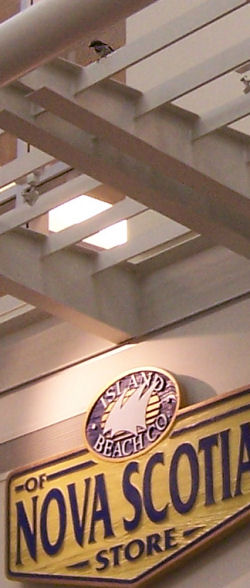
Sparrow looks down from rafters in the main atrium of Stanfield Halifax International Airport
If you’re bored in Halifax Stanfield International airport, you can always watch the birds in the central atrium. They’ll be watching you anyway. The atrium is full of cheerful chirping. There’s a sign that asks you not to feed the birds, so apparently their presence is intentional.
These aren’t pigeons or ducks that walk around on the floor; they’re little songbird types, and they mostly fly from rafter to rafter way up. If no one’s around they’ll swoop down to the level of the tropical plants behind the benches.
Next time (especially if I’m just picking someone up), I’ll bring my binoculars. The only one I saw close enough to identify was a house sparrow. But they aren’t all house sparrows, that much I could tell.
So, does anyone know about the birds in the airport, how long they’ve been there and what species they are?
If you’ve ever clicked on “Gift Shop” at the top, you’ll know that I’ve set up a CafePress shop with Nova Scotia gifts. I’ve ordered products from the shop myself, and have generally been pleased with the quality.
My favourite item is the rectangle fridge magnets. I just had a bunch made up with a Lunenburg scene in the background and the satellite image of Nova Scotia in the foreground. I’ll be using them as hostess gifts when travelling outside the province. They just arrived in the mail, and they’re really nice. The photo shows one of them along with others I’d ordered previously.
CafePress ships by mail from the US. Depending on what and how much you order, and perhaps on luck, you may have to pay duty and taxes on items shipped to Canada. In my limited experience so far, small packages of printed materials come right through. I ordered some T-shirts and had to pay what seemed like a lot of duty. Same with mugs. But the package of 10 fridge magnets arrived in my mailbox directly. And with the Canadian dollar near par, it’s a good time to order.
Chickadees live in a faster time dimension than we do, says my friend Dennis Robinson who has developed a close relationship with the birds around his home in the Annapolis Valley.
They are acutely aware of their surroundings, and communicate what is going on with each other, with other birds, and – because he listens – with him.
An intruder to their space is news, whether it is a new bird or a human.
Even a day later it can be big news, as he found when he returned home to find the grass torn up by ATV wheels and the chickadees unusually talkative.
This has got to be one of the coolest webcam locations in the world. It’s in Halls Harbour, where you can see the fishing boats go up and down with the world’s highest tides on the Bay of Fundy. Here’s how it looked today, Sunday March 14, at high tide. Go to www.novascotiawebcams.ca/hallsharbour/ (will open in new window or tab on your browser) and compare what you see with this.
Halls Harbour this morning at high tide. Some days the tide is even higher. Click the picture to go to the webcam and see what Halls Harbour looks like right now.
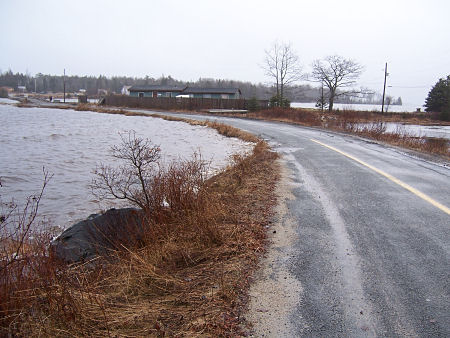
Back-to-back rainstorms this weekend have carried away most of the snow as well as the ice. The tide, augmented by full moon and a storm surge, was as high this morning as I’ve ever seen it.
At 8:30 this morning, at high tide, the water was almost level with the road leading to the Oak Island causway. Some small waves came onto the road from what is usually the sheltered side.Cannon directing its wrath at the sea.
On Friday night, our power was off for 2 1/2 hours, which is very unusual for us.
High tide that night coincided with high winds. Waves were splashing over the causeway.
The cannon in the photo at right used to point straight out at oncoming ships, but since Friday night it has been pointing downwards, as if to protect us from the wrath of Poseidon.
We are all delighted to hear that the entire crew of 64 aboard the tall ship Concordia, part of Lunenburg-based Class Afloat program, have been rescued off the coast of Brazil.
The high school and university age have certainly had an education in marine safety. The lesson should not be lost on other boaters, whether we take to the sea for pleasure or for work.
While we still don’t know exactly why the Concordia ran into trouble, the 100% survival rate was made possible by the use of proper safety equipment and procedures. An emergency position indicating radio beacon (EPIRB) sounded the alarm, adequate liferafts and zodiac boats were ready to go, and everyone aboard knew what to do. The liferafts kept everyone safe in high seas through the night until rescue could come.
Major Silvio Monteiro Junior, the head of the air command for the Brazil’s Search and Rescue System, speaking with CBC Radio’s As It Happens last night, spoke of the “beautiful” sight that met the rescuers eyes in the morning when the 3 merchant vessels and the liferafts used flares to communicate their positions to each other, and then the “incredible moment” when they knew that all 64 people were safely on board one or another vessel. He pointed out that Brazil and Canada have often worked together in search and rescue operations, and they were pleased to help us out. Thank you, Brazil.
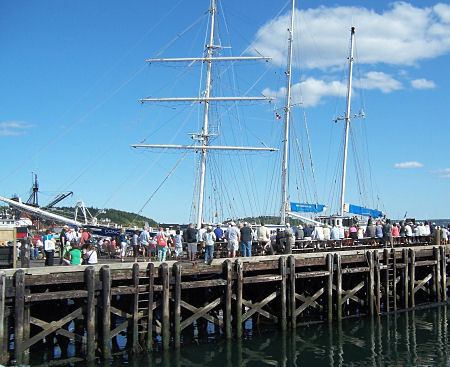
Lennie Gallant plays to the Lunenburg Folk Harbour Festival crowd in August, 2009, with SV Concordia as a backdrop.
Across from the tidal inlet near our house is a small island which is a symbolic destination for us, depending on the time of year. We celebrate spring, and the ice breaking up, by canoeing to it. In winter, if the ice is thick enough, we walk or skate to it. Today the ice was over 6 inches thick, the required minimum, and we walked there.