Derek Hatfield sails again

Derek Hatfield and Spirit of Canada, with some mutual friends, in Halifax Harbour
Derek Hatfield and Spirit of Canada, with some mutual friends, in Halifax Harbour. Photo by Ed Sulis.

Canada’s Derek Hatfield (who makes his home in Mahone Bay, Nova Scotia), was forced to retire from the Vendée Globe round the world, non-stop solo sailing race in December, due to damage to his boat.  He nursed his Algimouss Spirit of Canada to Hobart, Tasmania, where he fixed the damage, and on February 27, he left Hobart, determined to complete the course of the race, even if he is no longer officially in it.  Thus he will gain valuable solo experience and the knowledge of his Open 60 equal to that of anyone who completes such a race.  He will not get the support from the race organizers that he would have had were he still in the race.  However, he will be sailing along parts of the route in the company of some other major offshore races.

The Vendée Globe is gradually wrapping up with the final three boats now in the North Atlantic and due to reach France in the next couple of weeks.

Fair winds, Derek.  Hope to see you back home safe and sound in a couple of months!

Mystery tracks on the ocean ice

Mystery prints. Looks like 4 paws, then 4 paws, then something dragged for a distance, repeat.
Mystery prints

I saw these on the ice the other day.  What do you think it is?  It looks like 4 dog paws, then another set of 4 paws, then something dragged for a distance, repeat.  Leave comments below.

Seagulls or ducks?  The waddle suggests ducks to me. Pretty.
Seagulls or ducks?

And these?  Looks like ducks to me; I can imagine the waddle, and there are lots of ducks right here when the water is liquid.

Pretty snowfall

It was nice to have a snowfall that didn’t come with a storm.  Just 2 or 3 inches and sunshine to welcome February.  Isn’t that how it’s supposed to be?

The inlet, February 1, 2009
Snow on the sumac, February 1

An icy ocean wonderland to explore

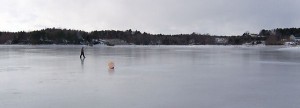
Walking on the ice past a mooring buoy, Jan. 25

We’ve had quite a long cold snap, and the ocean ice in and near our inlet is way over 6 inches thickness, the recommended thickness for safety.  Beautifully smooth too, in places, though the wind chill discouraged us from going back for our skates.

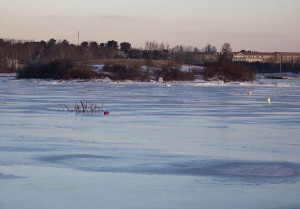
A branch which has been stuck in the ice for weeks now
A branch which has been stuck in the ice for weeks now, next to a mooring buoy, with other moorings in the background
We walked out to a small island and explored the ice formations around the rocks
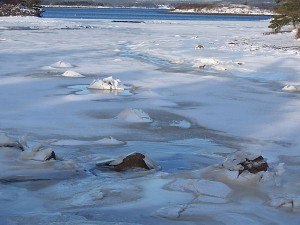
Along the shoreline at low tide, a weird and wonderful landscape to explore

At low tide, the ice is sitting on or near the bottom, so there’s little risk. It’s harder to get onto the ice when the tide is higher, as the broken pieces around the edge may not bear one’s weight, as my son learned this morning! No harm done, just wet boots and an uncomfortable trot home.

These rocks are just underwater at high tide, and we have to avoid them when rowing or paddling in the summer.
The big rocks in the middle are barely underwater at high tide, and we have to avoid them when rowing or paddling in the summer.

Derek Hatfield is looking for crew!

Got some serious cash and top-notch sailing skills? Want to sail the Southern Ocean in a very fast, well-equipped boat with an experienced skipper, take her round Cape Horn and up the South and North Atlantic to France?  Does Derek Hatfield have an opportunity for you!

Stranded in Tasmania after broken spreaders on the Open 60, Spirit of Canada, forced him to quit the Vendée Globe round-the-world solo race, Derek has been repairing the boat, but can’t afford to pack her in a crate and ship her back.  He has to sail her.  And this is where you come in – if you can outbid your competition, that is.  Go for it!

Get details on the Spirit of Canada website.

Derek Hatfield and “Spirit of Canada” stranded in Tasmania

Derek Hatfield is in Hobart, Tasmania, Australia, having carefully piloted his Open 60 sailboat, Spirit of Canada, to the closest shelter of land after the boat was damaged in the Vendée Globe solo, non-stop, round-the-world sailing race (“the Everest of sailing”).

Spirit of Canada had been hit by a huge wave that knocked the boat over and broke the spreaders high above the deck. The race’s rules require that participants repair any damage without any outside help if they are to stay in the race, but this damage is not something that Derek could have repaired alone.

In fact, of the 30 boats that started this race 50 days ago, only 12 remain in the running, so he is in very respectable company. A look at the race’s map (see www.vendeeglobe.org/en/ and click on the Map) shows the southernmost points of land littered with boats that have had to abandon the race.

“Spirit of Canada” has been a shoestring project all along, without the major corporate sponsorship and intense media interest enjoyed by Derek’s European competitors. The whole enterprise has been built on the small donations of thousands of Canadians. Now they have to get the boat back home to Nova Scotia, and fixed so it can participate in future Open 60 races. Shipping a boat like that is very expensive. However, sailing it home would require that it be fixed first, which has its own logistical challenges. If you can help support “Spirit of Canada” with a financial contribution, please do so. You can make a donation via their website, SpiritOfCanada.net, and send supportive e-mails to Derek from there as well.

The edge of the ice

The tidal inlet on January 2, 2009

Ice always builds up and stays in the inlets where it isn’t easily carried out to sea.  At low tide it just sits on the bottom, on the mud. There’s always a dynamic edge out there forming, melting, breaking off depending on the wave action, with pieces getting carried out to sea.

Freezing and thawing

The tidal inlet on the cold morning of December 9th

The temperature has been bouncing around like a yo-yo – rather like the price of gas, from minus 10 degrees C to plus 10 and back again within a few days.

Unlike fresh water, which is at its most dense around 4 degrees C, salt water is most dense at its freezing point, which is typically around minus 2 C.  The more salt is in the water, the lower its freezing point.  In oceans that freeze, the water deeper down is saltier, so it stays down, and is less likely to freeze because the high salt concentration lowers its freezing point considerably.  The lighter, relatively fresher water stays on top – so it’s more likely to freeze, and when it does freeze it has little salt in it, as I found out by tasting it.

Ice that formed over rocks at high tide, then bent and cracked as the tide fell.
Ice that formed over rocks at high tide, then bent and cracked as the tide fell - December 14.